Peptide Vial or Pen? Lyophilized vs. Pre-Dissolved Compared
Vial or pen? What lyophilization does, why dissolved peptides are subject to different stability risks, and how the two formats differ in the lab workflow.

A peptide vial is a small glass vial containing lyophilized, i.e., freeze-dried, peptide powder that is only brought into solution in the lab. A peptide pen contains the same compound already dissolved in a cartridge. Whether a vial or pen is the better fit depends on the experimental setup: the vial stands for flexibility and storage stability, the pen for standardized handling.
The question “Peptide vial or pen?” therefore does not concern the compound itself, but its physical state – solid or dissolved. However, precisely this difference has consequences for stability, storage, and workflow in the lab. The pharmaceutical literature on proteins and peptides has described well-documented basic principles on this for decades.[1][2]
In this article you'll learn what lyophilization means technically, why dissolved peptides are subject to different stability risks than dry ones, how the two formats differ in everyday lab work, and which formats SunPept offers. The article deliberately contains no instructions for use, amounts, or volumes.
At a glance
- Vial: Peptide as lyophilized (freeze-dried) powder in a sealed glass vial.
- Pen: Peptide already in solution, in a closed pen system.
- Lyophilization: considered the most common method for converting protein and peptide preparations into a solid, more storable form.[1]
- Stability in solution: Peptides in aqueous solution are more exposed to chemical degradation pathways such as deamidation, oxidation, and hydrolysis.[2][3]
- Compound: The compound is the same in both formats; differences concern state, handling, and storage.
- At SunPept: Retatrutide and GLOW as vial and pen, with linked Janoshik analysis reports.
What is a peptide vial?
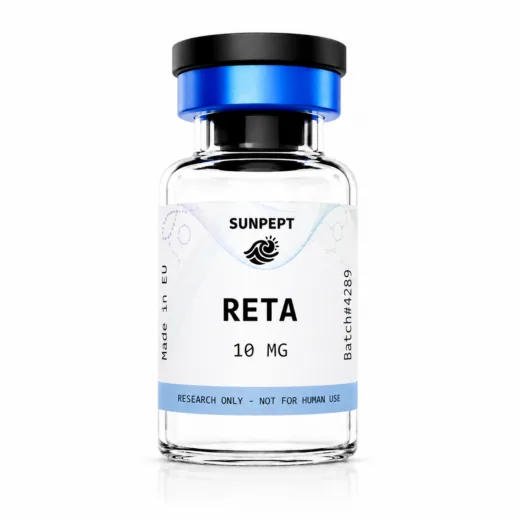
A vial is a small glass container sealed with a rubber stopper and a crimp cap. For research peptides, it usually contains a lyophilized powder – often referred to as a “cake” because the dried material takes the form of a porous, solid mass at the bottom of the container.
Lyophilized preparations must be reconstituted before use in the lab, i.e., dissolved in a suitable solvent. Which solvent and which concentration make sense depends on the respective experimental protocol and the properties of the compound. The advantage: researchers determine the timing of dissolution and the concentration themselves. The advantage lies in control over the entire preparation.
What is a peptide pen?
A pen is a closed system in which the peptide is already dissolved. This eliminates the reconstitution step in the lab. This reduces the number of work steps and thus potential sources of error, such as pipetting or calculation errors when preparing a solution. At the same time, the concentration is fixed by the format and cannot be freely chosen.
Regarding stability: a dissolved peptide is subject to different conditions than a dry one. This is where the degradation pathways in solution described in the literature come into play, which are explained in the next section. For pens, the storage instructions on the product page and label must therefore be followed particularly consistently.
Lyophilized vs. pre-dissolved: what the literature says about stability
The core difference between vial and pen is the water content. Water is not only a solvent but also a reaction partner and transport medium for many chemical degradation reactions. The reviews by Manning and colleagues, which have been considered a standard reference on the stability of protein pharmaceuticals since 1989, distinguish between chemical and physical instability.[2][3]
Chemical degradation pathways in solution
- Deamidation: Asparagine and glutamine residues can be converted into aspartic acid or glutamic acid with the release of ammonia, often via a cyclic succinimide intermediate.[2][4]
- Oxidation: Methionine, cysteine, tryptophan, and histidine in particular are sensitive to oxidation – influenced by oxygen, light, and trace metals.[2]
- Hydrolysis: Cleavage of peptide bonds, preferentially at certain sequence motifs, such as aspartate residues.[2]
- Other reactions: In peptide-containing products, pyroglutamate formation, diketopiperazine formation, and β-elimination, among others, have been described as typical degradation mechanisms.[4]
Physical instability
In addition to chemical changes, peptides and proteins in solution can aggregate, adsorb to surfaces, or precipitate. The tendency to do so depends strongly on sequence, concentration, pH, temperature, and mechanical stress.[3]
Why drying stabilizes – and where the limits lie
Lyophilization removes most of the water from the preparation. This greatly slows down many water-dependent reactions. According to the comprehensive review by Wang, freeze-drying is the most frequently used method for producing solid protein preparations with acceptable shelf life.[1] However, the process is not free of stress: freezing and drying themselves create stresses, and long-term stability can be limited even in the solid state. That is why stabilizers (lyoprotectants) are frequently used in pharmaceutical formulations, and the drying cycle is designed deliberately.[1][5]
The three phases of freeze-drying
- Freezing: The solution is frozen; water crystallizes into ice, and dissolved components concentrate in the remaining phase.
- Primary drying: Under vacuum, the ice sublimates directly from the solid to the gaseous state.
- Secondary drying: Bound residual water is removed by desorption at a moderately elevated temperature.
This basic principle and the associated process parameters are described in detail in the literature.[1][5]
Storage: general principles from the literature
For both formats: the specific storage recommendation depends on the substance and its formulation and is stated on the product page or label. However, general principles can be derived from the stability literature that explain why storage instructions are worded the way they are:[2][3]
- Temperature: Chemical degradation reactions proceed more slowly at lower temperatures. Cool storage therefore slows down degradation processes.
- Light: Light can promote oxidation reactions; storage protected from light is therefore a common standard.
- Moisture: Lyophilisates are hygroscopic. A tightly sealed vial protects against water uptake from the ambient air.
- Mechanical stress: Vigorous shaking can promote aggregation at interfaces in solutions; careful handling is therefore standard practice.
These principles are general and do not replace the specific information for a given product.
Handling in the lab: workflow compared
In day-to-day lab work, the formats differ mainly in the number of work steps and in the degrees of freedom of the experimental setup.
Workflow with the Vial
With the Vial, reconstitution is part of the lab protocol. This requires aseptic technique, suitable solvents, and clean documentation of batch, date, and concentration. In return, the concentration can be adapted to different research questions, and material that is not needed can remain in dry form until it is required.
Workflow with the Pen
With the Pen, there is no need to prepare the solution. This saves time and standardizes the starting conditions across experimental series. The downside is the fixed concentration and the fact that the substance has been in solution since manufacture.
Documentation: what both formats have in common
Regardless of format, complete documentation is the foundation of reproducible research. This includes the batch number, date of receipt, storage location and conditions, and, for vials, the date and parameters of reconstitution. Analysis reports, for example on identity and content by HPLC and mass spectrometry, always refer to a specific batch. It is therefore worth filing the report number together with your own experimental data. The literature on impurities in peptide products shows that synthesis- and degradation-related by-products can distort early experimental results – one more reason to know the analytics of the batch you use.[4] You'll find an overview of available reports at Test reports.
Vial vs. pen: comparison table
| Criterion | Vial (lyophilized) | Pen (pre-dissolved) |
|---|---|---|
| Physical state | solid powder (lyophilisate) | Solution |
| Reconstitution in the lab | required | not needed |
| Concentration | freely selectable per lab protocol | set by the format |
| Typical stability risks | Moisture uptake, stress from drying | Degradation pathways in solution (e.g., deamidation, oxidation, aggregation) |
| Work steps | more (preparation, documentation) | fewer |
| Standardization | depends on the lab | high |
| Suitable for | variable experimental designs, longer-term storage | repeatable workflows with fixed conditions |
Which format for which research setup?
There is no universally “better” choice. It makes sense to decide based on a few guiding questions:
- Do you need different concentrations? Then the Vial offers more flexibility.
- Do you want to keep material in stock for a longer period? According to the literature, the solid form of the lyophilisate is generally more favorable for this.[1]
- Is the reproducibility of a fixed workflow the priority? Then the Pen reduces variables during preparation.
- How is your lab equipped? Aseptic reconstitution requires suitable equipment and routine.
Vial and pen at SunPept
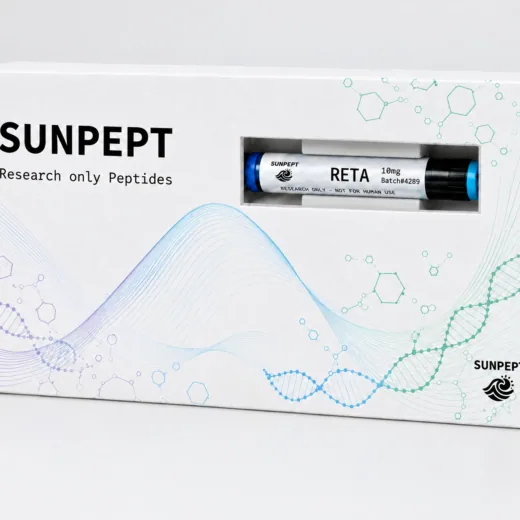
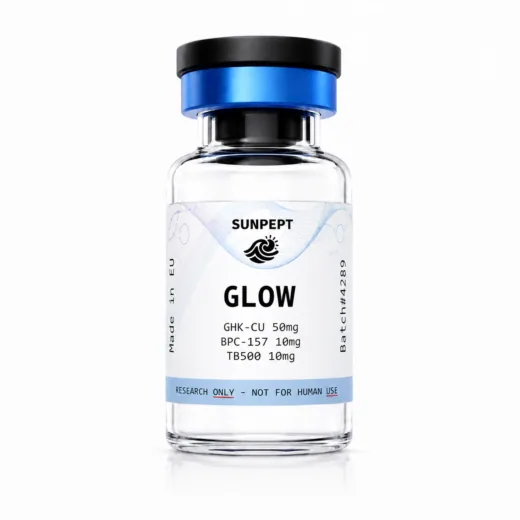
SunPept carries several substances in both formats. For Retatrutide, you can choose between the Retatrutide Vial (lyophilized, contents include 3 ml bacteriostatic water) and the Retatrutide Pen (pre-dissolved), each with 10, 20, or 30 mg total content. The multi-component blend GLOW (GHK-Cu 50 mg, BPC-157 10 mg, and TB-500 10 mg, 70 mg in total) is available as the GLOW Vial and as the GLOW Pen.
For Retatrutide and GLOW, analysis reports from the Janoshik lab are linked on the respective product page, so you can view the documentation for your chosen format directly. All products are supplied for research purposes only.
Frequently asked questions
What is the difference between a peptide vial and a peptide pen?
In a vial, the peptide is present as a lyophilized, i.e., freeze-dried, powder and is brought into solution in the lab according to protocol. In a pen, the compound is already dissolved. The compound is the same; the formats differ in physical state, stability conditions, work steps, and whether the concentration can be freely chosen.
Why are peptides freeze-dried?
Freeze-drying removes most of the water from the preparation. Many chemical degradation reactions, such as deamidation or hydrolysis, proceed much more slowly without water. According to the scientific literature, lyophilization is therefore the most common method for converting protein and peptide preparations into a more storable, solid form.
Is a pen less stable than a vial?
Dissolved peptides are generally exposed to different degradation pathways than dry ones, such as oxidation, deamidation, or aggregation. How relevant this is depends on sequence, formulation, and storage conditions. It is therefore essential to consistently follow the storage instructions on the product page and label.
Do the vial and pen contain the same compound?
Yes, the compound is the same in both formats – for example Retatrutide or the GLOW blend. The differences lie in the state (solid or dissolved) and in handling. For Retatrutide and GLOW, Janoshik analysis reports are linked on the respective product page, so you can view the documentation for each format.
Are there reconstitution instructions?
No. SunPept supplies peptides exclusively for research purposes and provides no information on volumes, concentrations, or use. The solvent and concentration are defined by the respective experimental protocol, tailored to the properties of the compound and the research question. Our glossary explains general terms.
Which format is better suited for stockkeeping?
For longer-term stockkeeping, the solid, lyophilized form is generally considered more favorable according to the stability literature, because water-dependent degradation reactions are slowed down. The pen plays to its strengths when a standardized, repeatable workflow is more important. The product-specific storage instructions remain decisive.
Sources
- Wang W. Lyophilization and development of solid protein pharmaceuticals. Int J Pharm. 2000;203(1–2):1–60. doi:10.1016/S0378-5173(00)00423-3
- Manning MC, Patel K, Borchardt RT. Stability of protein pharmaceuticals. Pharm Res. 1989;6(11):903–918. doi:10.1023/A:1015929109894
- Manning MC, Chou DK, Murphy BM, Payne RW, Katayama DS. Stability of protein pharmaceuticals: an update. Pharm Res. 2010;27(4):544–575. doi:10.1007/s11095-009-0045-6
- D’Hondt M, Bracke N, Taevernier L, et al. Related impurities in peptide medicines. J Pharm Biomed Anal. 2014;101:2–30. doi:10.1016/j.jpba.2014.06.012
- Carpenter JF, Pikal MJ, Chang BS, Randolph TW. Rational design of stable lyophilized protein formulations: some practical advice. Pharm Res. 1997;14(8):969–975. doi:10.1023/A:1012180707283
Research Use Only: All peptides available from SunPept – whether as Vial or Pen – are intended exclusively for scientific laboratory research. They are not medicinal products and are not intended for human or veterinary use.
The compound from this article in the shop
Vial (lyophilized) or Pen (pre-dissolved), Janoshik analysis reports linked where available. Shipped from the EU to 25 countries. For research purposes only.