TB-500: Thymosin β4 Fragment, Actin Binding, and State of Research
TB-500 is the acetylated fragment 17–23 of thymosin β4. Structure, actin biology, preclinical findings, state of the evidence, and WADA status – clearly separated from the parent protein.

TB-500 is a synthetic peptide that corresponds to region 17–23 of the protein thymosin β4: the sequence LKKTETQ with an acetylated N-terminus (Ac-LKKTETQ). This segment is considered the central actin-binding domain of thymosin β4. TB-500 is therefore not identical to the full-length, 43-amino-acid protein.
In online discussions, “TB-500” and “thymosin β4” are often used synonymously – scientifically, this is imprecise. Most published research concerns the full-length protein thymosin β4 (Tβ4); on the isolated fragment TB-500, there are mainly analytical papers from doping control and a few cell studies. This article clearly separates the two, explains actin biology, and summarizes the preclinical evidence.
All findings described come from cell culture and animal models or – for full-length Tβ4 – from early clinical trials of specific formulations. They are not a statement about any benefit of TB-500 for you.
At a glance
- Compound class: synthetic heptapeptide, N-terminally acetylated
- Sequence: Ac-Leu-Lys-Lys-Thr-Glu-Thr-Gln (Ac-LKKTETQ), corresponds to amino acids 17–23 of thymosin β4[3][4]
- Molecular formula / molecular mass: C38H68N10O14, approx. 889.0 g/mol (PubChem CID 62707662)
- Parent protein: Thymosin β4 – 43 amino acids, approx. 4.9 kDa, the main G-actin-sequestering protein in eukaryotic cells[2]
- Research focus: actin dynamics, cell migration, angiogenesis and wound models (preclinical)
- Approval / anti-doping: no marketing authorization as a medicinal product; WADA Prohibited List S2: “thymosin β4 and its derivatives, e.g., TB-500”[10]
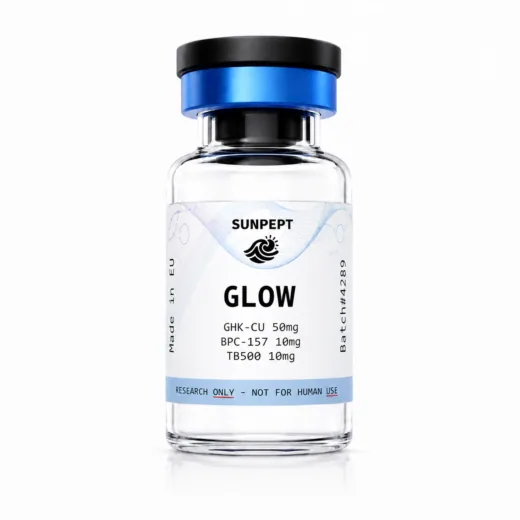
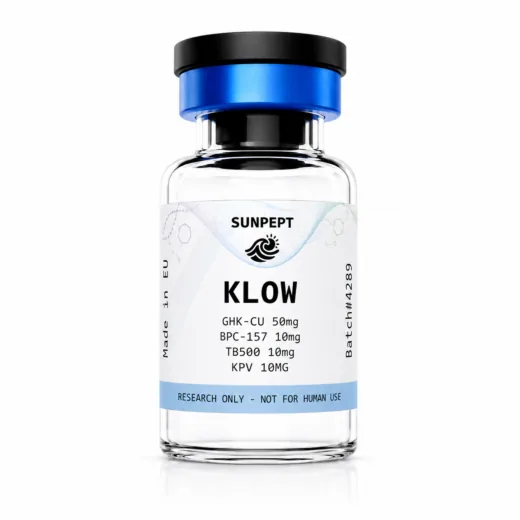
- At SunPept: not available as a single substance – component of GLOW and KLOW
Thymosin β4 and TB-500: the difference
Thymosin β4 is a small protein of 43 amino acids found in almost all cells and body fluids. It is the most important actin-sequestering molecule of eukaryotic cells and binds monomeric G-actin[2]. As early as 2005, Goldstein, Hannappel, and Kleinman described Tβ4 as an actin-binding protein that additionally shows extracellular functions in tissue repair models[5].
Sosne et al. (2010) attributed various biological activities of Tβ4 to short sequence segments[2]:
| Segment of Tβ4 | Sequence | Activity attributed in models |
|---|---|---|
| N-terminus (aa 1–4) | Ac-SDKP | Inflammation and fibrosis models |
| N-terminus (aa 1–15) | incl. Ac-SDKP | Cell survival, apoptosis models |
| Central actin-binding domain (aa 17–23) | LKKTETQ | Angiogenesis, wound models, cell migration |
TB-500 is based on exactly this central segment. In 2012, analysts at the Hong Kong Jockey Club described TB-500 as a preparation whose key component is the peptide LKKTETQ with artificial N-terminal acetylation[3]; Rahaman et al. (2024) also use the definition Ac-LKKTETQ[4]. A common mistake: the N-terminal tetrapeptide Ac-SDKP is a different Tβ4 fragment and not TB-500.
Why the distinction matters
Findings on full-length Tβ4 cannot automatically be transferred to the heptapeptide. Rahaman et al. noted that biological effects of TB-500 itself had barely been documented up to that point, and reported that in their fibroblast migration assay, only the metabolite Ac-LKKTE – not the parent substance – showed a significant effect[4]. Anyone researching TB-500 should therefore always check the literature for which molecule was actually studied.
Mechanism of action: what research shows
Actin binding and the cytoskeleton
A large part of a cell's cytoskeleton consists of actin, which alternates between monomeric G-actin and filamentous F-actin. Tβ4 binds G-actin and thus keeps a pool of monomers available for rapid remodeling processes – for example during cell migration. The region around LKKTETQ is centrally involved in this binding[1][2].
Cell migration and angiogenesis in models
For full-length Tβ4, the following findings, among others, have been reported in preclinical models:
- Wound models: Malinda et al. (1999) studied Tβ4 in a rat model with full-thickness wounds and reported faster re-epithelialization, more collagen deposition, and angiogenesis compared with the saline control, as well as increased keratinocyte migration in the Boyden chamber assay[6].
- Cardiac models: Bock-Marquette et al. (2004) reported in Nature activation of integrin-linked kinase (ILK) as well as effects on the migration and survival of cardiac cells in a mouse model[7].
- Epicardial progenitor cells: Smart et al. (2007) reported that Tβ4 can mobilize epicardial progenitor cells and trigger neovascularization in adult mouse hearts[8].
The review by Goldstein, Hannappel, Sosne, and Kleinman (2012) summarizes that, after tissue damage, Tβ4 is released by platelets and macrophages, among others, influences the migration of stem and progenitor cells, and was associated with fewer myofibroblasts and less fibrosis in models[1]. These statements refer to the protein, not to TB-500.
Preclinical findings on TB-500 itself
The literature on the isolated fragment is considerably narrower. The most important papers come from analytics:
- Ho et al. (2012): Development of an LC-MS method for detecting N-acetylated LKKTETQ and its metabolites in equine urine and plasma – motivated by misuse in equestrian sport[3].
- Rahaman et al. (2024): Study of metabolism in human serum, enzyme systems, and a rat model. Ac-LK was identified as the main metabolite; Ac-LKK was detectable for up to 72 hours. No cytotoxicity was observed in fibroblasts for the parent substance and metabolites[4].
For experimental planning, this means: TB-500 is apparently rapidly broken down into shorter fragments in biological matrices, and the question of which species is actually active in a model remains open.
Clinical evidence and approval status
No clinical trials have been published for TB-500. Full-length Tβ4, by contrast, has been tested clinically in specific formulations. One example is a small randomized, double-masked, placebo-controlled phase 2 trial of Tβ4 eye drops (RGN-259) in nine people with severe dry eye, in which symptom and sign scales were recorded over 56 days[9]. Such trials concern a different molecule, a different site of application, and a pharmaceutical formulation; they say nothing about TB-500.
There is no marketing authorization as a medicinal product for either TB-500 or Tβ4. The state of research is thus clearly preclinical or – for the protein – early clinical.
Safety data from studies
Regarding side effects: no human data exist for TB-500. From preclinical analytics, it has only been reported that neither the parent substance nor the metabolites studied were cytotoxic in fibroblast cytotoxicity tests[4]. In the phase 2 trial with Tβ4 eye drops, the drops were described as well tolerated[9] – with a very small sample size and a different molecule. Reliable statements on the safety of TB-500 in humans are therefore not possible.
Anti-doping: TB-500 on the WADA list
In section S2 (“Peptide hormones, growth factors, related substances, and mimetics”), under growth factors and growth factor modulators, the World Anti-Doping Agency expressly lists “thymosin β4 and its derivatives, e.g., TB-500.” The substances in this section are prohibited at all times, in and out of competition[10]. The detection methods from equestrian sport analytics show that TB-500 and its metabolites are also tested for in animal sports[3].
For the legal classification of purchasing for research purposes – which depends on the substance, country, and intended use – you'll find a neutral overview at Research peptides and the legal situation in Germany offers a neutral overview (not legal advice).
TB-500 in multi-component research
In tissue research, TB-500 is often mentioned together with BPC-157, because both have been studied in migration and vascular models – via different mechanisms (actin binding for TB-500, VEGFR2/FAK/NO for BPC-157; see BPC-157: research overview). There are no controlled studies on the combination. How multi-component approaches are structured is explained in the article GLOW & KLOW.
Sourcing for research
TB-500 is not available on its own at SunPept. It is a component of two research combinations:
- GLOW Vial (lyophilized) and GLOW Pen (pre-dissolved): GHK-Cu 50 mg, BPC-157 10 mg, TB-500 10 mg – Janoshik analysis reports linked at Test reports.
- KLOW Vial: additionally KPV 10 mg – analysis documentation on request.
Shipping within the EU from the Czech Republic, payment by prepayment; at checkout, you confirm use for research purposes only. You'll find prices on the product pages. Further topics from this field are collected in the section Tissue Research.
Frequently asked questions
Is TB-500 the same as thymosin β4?
No. Thymosin β4 is a natural protein made up of 43 amino acids. TB-500 is a synthetic heptapeptide that corresponds to the actin-binding region 17–23 (LKKTETQ) and is acetylated at the N-terminus. Most published findings concern the full-length protein and cannot be transferred directly to the fragment.
What does research show about the effects of TB-500?
For full-length Tβ4, effects on actin dynamics, cell migration, and angiogenesis have been reported in animal models. For TB-500 itself, there are mainly metabolism and analytical studies. A 2024 study found a significant effect in a fibroblast assay only for the metabolite Ac-LKKTE, not for the parent substance.
Is there dosing information for TB-500?
No. TB-500 is not approved and is supplied exclusively for research. There are no usage or dosing recommendations. Concentrations and experimental conditions are defined solely by the respective research protocol; SunPept provides no information on this.
Which side effects of TB-500 are known?
No human data are available for TB-500, so no side effects in humans are documented – this is not evidence of safety. Preclinically, no cytotoxicity of TB-500 and its metabolites was observed in fibroblasts. Clinical data exist only for specific Tβ4 formulations, such as eye drops.
Is TB-500 banned in sport?
Yes. In section S2, under the growth factor modulators, the WADA Prohibited List expressly names “thymosin β4 and its derivatives, e.g., TB-500.” These substances are prohibited at all times. TB-500 is also tested for in equestrian sport using dedicated LC-MS methods.
Can I buy TB-500 on its own?
Not at SunPept. TB-500 is available exclusively as a component of the research combinations GLOW (Vial and Pen, with Janoshik reports) and KLOW (Vial, analysis documentation on request). Both are Research Use Only products for laboratory investigations.
Sources
- Goldstein AL, Hannappel E, Sosne G, Kleinman HK. Thymosin β4: a multi-functional regenerative peptide. Basic properties and clinical applications. Expert Opin Biol Ther. 2012;12(1):37-51. doi:10.1517/14712598.2012.634793
- Sosne G, Qiu P, Goldstein AL, Wheater M. Biological activities of thymosin beta4 defined by active sites in short peptide sequences. FASEB J. 2010;24(7):2144-2151. doi:10.1096/fj.09-142307
- Ho EN, Kwok WH, Lau MY, et al. Doping control analysis of TB-500, a synthetic version of an active region of thymosin β4, in equine urine and plasma by liquid chromatography-mass spectrometry. J Chromatogr A. 2012;1265:57-69. doi:10.1016/j.chroma.2012.09.043
- Rahaman KA, Muresan AR, Min H, et al. J Chromatogr B Analyt Technol Biomed Life Sci. 2024;1235:124033. doi:10.1016/j.jchromb.2024.124033
- Goldstein AL, Hannappel E, Kleinman HK. Thymosin beta4: actin-sequestering protein moonlights to repair injured tissues. Trends Mol Med. 2005;11(9):421-429. doi:10.1016/j.molmed.2005.07.004
- Malinda KM, Sidhu GS, Mani H, et al. J Invest Dermatol. 1999;113(3):364-368. doi:10.1046/j.1523-1747.1999.00708.x
- Bock-Marquette I, Saxena A, White MD, DiMaio JM, Srivastava D. Thymosin beta4 activates integrin-linked kinase and promotes cardiac cell migration, survival and cardiac repair. Nature. 2004;432(7016):466-472. doi:10.1038/nature03000
- Smart N, Risebro CA, Melville AA, et al. Thymosin beta4 induces adult epicardial progenitor mobilization and neovascularization. Nature. 2007;445(7124):177-182. doi:10.1038/nature05383
- Sosne G, Dunn SP, Kim C. Thymosin β4 significantly improves signs and symptoms of severe dry eye in a phase 2 randomized trial. Cornea. 2015;34(5):491-496. doi:10.1097/ICO.0000000000000379
- World Anti-Doping Agency (WADA). International Standard – Prohibited List 2026, Section S2 “Peptide hormones, growth factors, related substances, and mimetics.” In force since January 1, 2026. wada-ama.org/en/prohibited-list
Research Use Only: All substances available from SunPept are intended exclusively for in vitro research and laboratory investigations. They are not medicinal products, foods, or cosmetics and are not intended for human or veterinary use. Learn more at Research Use Only.
The compound from this article in the shop
Vial (lyophilized) or Pen (pre-dissolved), Janoshik analysis reports linked where available. Shipped from the EU to 25 countries. For research purposes only.