BPC-157: Origin, Mechanisms, and Evidence for the Gastric Peptide
BPC-157 research overview: pentadecapeptide from a gastric juice protein, preclinical models, lack of clinical trials, WADA status S0 – with verified primary sources.

BPC-157 is a synthetic pentadecapeptide of 15 amino acids that is considered a partial sequence of a protein described in human gastric juice (“Body Protection Compound,” BPC). Since the early 1990s, it has been investigated mainly preclinically – in cell, tissue, and animal models. No controlled clinical trials in humans have been published to date.
Few research peptides are discussed online as often as BPC-157 – and few have such a large gap between animal data and robust human data. This article explains where the peptide comes from, which signaling pathways have been investigated in models, what the safety and study data actually show, and what regulatory status BPC-157 has.
Important up front: all findings cited here are results of basic research. They cannot be transferred to humans and are not a statement about any benefit for you.
At a glance
- Compound class: synthetic linear peptide (pentadecapeptide, 15 amino acids)
- Sequence: Gly-Glu-Pro-Pro-Pro-Gly-Lys-Pro-Ala-Asp-Asp-Ala-Gly-Leu-Val (GEPPPGKPADDAGLV)
- Molecular formula / molecular mass: C62H98N16O22, approx. 1,419.5 g/mol (PubChem CID 9941957)
- Origin: partial sequence of a protein isolated from gastric juice (BPC, approx. 40 kDa), described by the research group led by Predrag Sikirić, Zagreb[1]
- Pathways investigated: VEGFR2–Akt–eNOS, FAK–paxillin, nitric oxide (NO) system – preclinical[4][5]
- State of the evidence: predominantly animal models; human data are limited to a retrospective case series and a pilot study with two individuals[7][8][9]
- Approval / anti-doping: no marketing approval as a medicinal product; explicitly named on the WADA Prohibited List under S0 “Non-approved substances”[10]
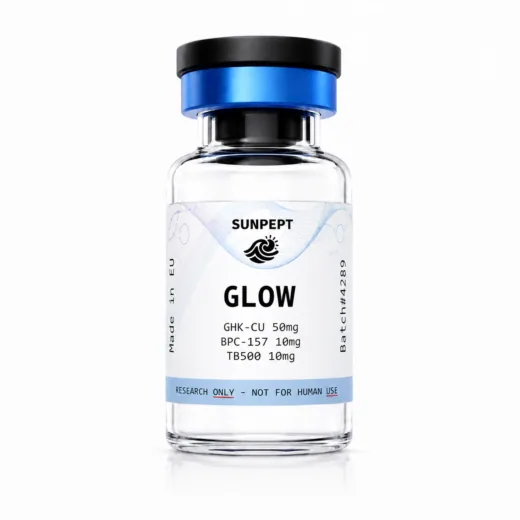
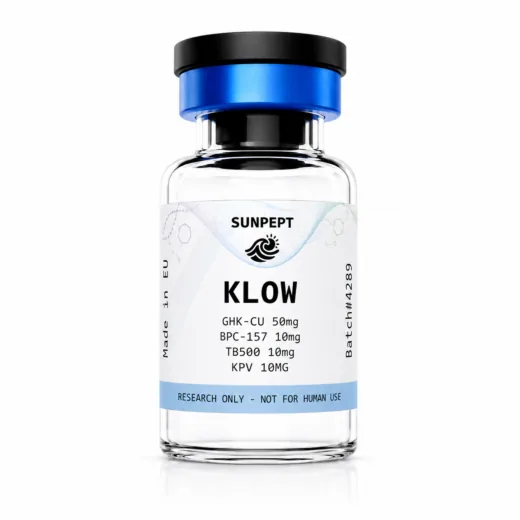
- At SunPept: not available as a single substance – component of the research combinations GLOW and KLOW
What is BPC-157? Origin and structure
The name goes back to a 1993 paper by the Zagreb group led by Sikirić. It describes a peptide isolated from gastric juice with a relative molecular mass of around 40,000, which the authors named “BPC.” A 15-amino-acid fragment derived from it – BPC 157 – was considered essential for its activity, fully characterized, and investigated in various lesion models[1]. The underlying concept is so-called “cytoprotection” or “organoprotection”: the hypothesis that the stomach, as a neuroendocrine organ, is involved in an overarching protective response to stress.
Chemically, BPC-157 is a comparatively small, linear peptide without disulfide bridges. In the literature, it is often referred to as a “stable gastric pentadecapeptide” – a reference to the stability in gastric juice described by the research group[2]. For research purposes, it is now produced fully synthetically by solid-phase peptide synthesis; natural occurrence of the isolated 15-mer in the body is not documented to the same extent as that of the parent protein.
Where does the name “Body Protection Compound” come from?
The name is a working designation by the original authors and reflects their hypothesis – it is not a statement about any proven effect. For a sober assessment, it helps to read “BPC-157” simply as the name of a defined amino acid sequence. You can find general background on peptides in the article What are peptides?.
Mechanism of action: what research shows
Scientifically, the question of BPC-157’s “effects” can only be answered at the level of model systems. Three signaling axes in particular have been investigated – each in cell culture or in animal models.
VEGFR2 and angiogenesis signaling
Hsieh et al. (2017) investigated BPC-157 in the chick chorioallantoic membrane assay, in a tube formation assay with endothelial cells, and in a rat model of hindlimb ischemia. They reported higher vessel density in the models as well as increased expression and internalization of VEGF receptor 2 (VEGFR2) – but not of VEGF-A itself. The authors also described a time-dependent activation of the VEGFR2–Akt–eNOS cascade that could be suppressed by the endocytosis inhibitor Dynasore[5].
FAK–paxillin and fibroblast migration
Chang et al. (2011) worked with tendon explants and tendon fibroblasts from the rat Achilles tendon. They reported increased fibroblast outgrowth from the explants, higher cell survival under H2O2-stress, and dose-dependently increased migration in the transwell assay. Cell proliferation itself was not directly altered in the MTT assay. At the molecular level, increased phosphorylation of FAK and paxillin was observed, with unchanged total protein levels[4].
NO system and vascular models
In numerous rat models, the Sikirić group has described interactions with the nitric oxide system, for example in experiments with the NOS inhibitor L-NAME and with L-arginine, as well as findings in thrombosis and vascular occlusion models and on the recruitment of collateral vessels[2]. Seiwerth et al. summarized the findings on BPC-157 and classic angiogenic growth factors in tendon, ligament, muscle, and bone models in a review article[3].
How robust are these mechanisms?
A large part of the literature comes from a single research group, many models are rat models with small sample sizes, and no specific receptor for BPC-157 has been identified to date. The systematic review by Vasireddi et al. (2025) included 36 studies, 35 of them preclinical and one clinical, and rated the evidence as Level IV or V[7]. Mechanistic findings are therefore hypotheses for further research – not established pharmacology.
| Axis investigated | Model system | Reported finding | Source |
|---|---|---|---|
| VEGFR2–Akt–eNOS | Endothelial cells, CAM assay, rat (hindlimb ischemia) | higher VEGFR2 expression and internalization, activation of the cascade | Hsieh et al. 2017[5] |
| FAK–paxillin | Rat tendon fibroblasts, ex vivo/in vitro | more migration and spreading, increased phosphorylation | Chang et al. 2011[4] |
| NO system, vascular models | various rat models | Interaction with L-NAME/L-arginine, collateral vessels | Sikirić et al. 2018[2] |
| Pharmacokinetics | Rat, beagle | Elimination half-life of the parent compound < 30 min, degradation into peptide fragments | He et al. 2022[6] |
Overview of preclinical models
The preclinical literature covers a strikingly broad range of organ systems. Frequently investigated were:
- Gastrointestinal models: Lesion models of the stomach and intestine, fistula and anastomosis models – the historical starting point of the research[2].
- Musculoskeletal models: Transection and defect models of tendon, ligament, muscle, and bone in the rat[3][7].
- Vascular models: Thrombosis, occlusion, and ischemia models[2][5].
- Cell models: Endothelial cells and fibroblasts for studying migration, spreading, and signal transduction[4][5].
On pharmacokinetics, the study by He et al. (2022) provides the first systematic data from rats and beagles: after intravenous and intramuscular administration, the elimination half-life of the unchanged compound was under 30 minutes; radiolabeled BPC-157 was rapidly degraded into smaller peptide fragments and amino acids and excreted via urine and bile[6]. These data are relevant for planning preclinical study designs but do not allow any conclusions about humans.
You can find a thematic overview of related research fields in the section Tissue Research.
Human data and clinical evidence
This is the decisive point for any serious assessment: there are no published randomized controlled clinical trials on BPC-157. The Sikirić group mentions earlier clinical trials (including in ulcerative colitis), but no peer-reviewed outcome data from controlled trials are available[2].
The available human data are limited to two small publications in the same journal:
- Lee & Padgett (2021): retrospective review of patient records with telephone follow-up (16 people reached) from a single practice; no control group, no blinding, and no standardized measurement instruments[8].
- Lee & Burgess (2025): pilot tolerability study with two participants; laboratory parameters and vital signs were examined over three days[9].
Neither study is methodologically suited to support statements about efficacy or safety. The systematic review by Vasireddi et al. notes that no clinical safety data were found[7].
Safety data from studies
On the question of “side effects,” we can only report what has been published – and that is little:
- In 1993, the original authors reported observing no toxicity and no effect on various baseline parameters in their animal models[1].
- Vasireddi et al. summarize that preclinical safety studies showed no adverse effects in several organ systems, but that clinical safety data are lacking. The authors also point to risks from unregulated manufacturing and possible contamination[7].
- In the pilot study by Lee & Burgess, no changes in the tested laboratory parameters and no adverse events were reported in two individuals[9] – a sample size that permits no generalization whatsoever.
In other words: there are no robust safety data for humans. The absence of reported side effects in very small studies is not evidence of safety.
Approval and anti-doping status
BPC-157 has not been approved as a medicinal product by any drug regulatory authority. The World Anti-Doping Agency (WADA) explicitly lists BPC-157 as an example in category S0 “Non-approved substances” of its Prohibited List – i.e., pharmacological substances without current regulatory approval for human therapeutic use. The category applies at all times, in and out of competition; BPC-157 has been named there since the 2022 list and is also included in the 2026 list[10].
The legal classification of purchasing for research purposes depends on the substance, the country, and the intended use. A neutral overview is provided in the article Research peptides and the legal situation in Germany – it is not a substitute for legal advice.
“BPC-157 and TB-500”: why the two are often mentioned together
The search query “bpc 157 tb 500” is common. The background is that both peptides appear in the literature on tissue and vascular models, but via different mechanisms: BPC-157 is studied in the context of VEGFR2, FAK, and NO signaling, TB-500 as a synthetic fragment of the actin-binding protein thymosin β4 (more on this in the article TB-500 and thymosin β4).
Important: there are no published controlled studies that have systematically investigated a combination of the two substances. Combinations should therefore be understood as research approaches, not as proven concepts. At SunPept, BPC-157 and TB-500 are components of the multi-component research compounds GLOW and KLOW.
Sourcing for research
BPC-157 is not available as a single compound at SunPept. For research projects that look at several components in parallel, two combinations are available:
- GLOW Vial (lyophilized) and GLOW Pen (pre-dissolved): GHK-Cu 50 mg, BPC-157 10 mg, TB-500 10 mg – with Janoshik analysis reports linked on the page Test reports.
- KLOW Vial: GLOW components plus KPV 10 mg – analysis documentation on request.
Shipping within the EU is from the Czech Republic, payment is by prepayment, and at checkout you confirm exclusive use for research purposes. Current prices are shown on the respective product pages.
Frequently asked questions
What is BPC-157?
BPC-157 is a synthetic peptide of 15 amino acids (GEPPPGKPADDAGLV) that is considered a partial sequence of a protein described from human gastric juice. Since the 1990s, it has been investigated mainly in cell and animal models, for example with regard to angiogenesis signaling and fibroblast migration. It has no marketing approval as a medicinal product.
What effects of BPC-157 does research describe?
Robust statements exist only for model systems. In cell and rat models, effects on the VEGFR2–Akt–eNOS cascade, FAK–paxillin phosphorylation, and the NO system have been reported. No specific receptor is known, and controlled human studies are lacking. The findings therefore cannot be transferred to humans.
Is there dosage information for BPC-157?
No. BPC-157 is an unapproved Research Use Only substance for which there are no usage or dosage recommendations. Experimental parameters such as concentrations or routes of application are defined exclusively by the respective approved research protocol. SunPept provides no recommendations on this.
Which side effects are known?
No robust safety data are available for humans. Preclinical studies report no toxicity in the models investigated; a pilot study with two individuals reported no adverse events. A 2025 systematic review explicitly states that clinical safety data are lacking and that contaminants pose a risk.
Is BPC-157 on the doping list?
Yes. WADA explicitly names BPC-157 as an example in category S0 “Non-approved substances.” Substances in this category are prohibited at all times, i.e., both in and out of competition. It has been listed since the 2022 list and is also included in the 2026 Prohibited List.
Can I buy BPC-157 on its own from SunPept?
No. BPC-157 is currently not available from SunPept as a single substance. It is included as a component in the research combinations GLOW (Vial and Pen) and KLOW (Vial). Janoshik analysis reports are linked for GLOW; for KLOW, analysis documentation is available on request.
Sources
- Sikirić P, Petek M, Rucman R, et al. A new gastric juice peptide, BPC. An overview of the stomach-stress-organoprotection hypothesis and beneficial effects of BPC. J Physiol Paris. 1993;87(5):313-327. doi:10.1016/0928-4257(93)90038-u
- Sikiric P, Rucman R, Turkovic B, et al. Curr Pharm Des. 2018;24(18):1990-2001. doi:10.2174/1381612824666180608101119
- Seiwerth S, Rucman R, Turkovic B, et al. Curr Pharm Des. 2018;24(18):1972-1989. doi:10.2174/1381612824666180712110447
- Chang CH, Tsai WC, Lin MS, Hsu YH, Pang JH. J Appl Physiol. 2011;110(3):774-780. doi:10.1152/japplphysiol.00945.2010
- Hsieh MJ, Liu HT, Wang CN, et al. J Mol Med (Berl). 2017;95(3):323-333. doi:10.1007/s00109-016-1488-y
- He L, Feng D, Guo H, et al. Front Pharmacol. 2022;13:1026182. doi:10.3389/fphar.2022.1026182
- Vasireddi N, Hahamyan H, Salata MJ, et al. Emerging Use of BPC-157 in Orthopaedic Sports Medicine: A Systematic Review. HSS J. 2025;21(4):485-495. doi:10.1177/15563316251355551
- Lee E, Padgett B. Altern Ther Health Med. 2021;27(4):8-13. PMID: 34324435
- Lee E, Burgess K. Altern Ther Health Med. 2025;31(5):20-24. PMID: 40131143
- World Anti-Doping Agency (WADA). International Standard – Prohibited List 2026, section S0 “Non-approved substances.” In effect since January 1, 2026. wada-ama.org/en/prohibited-list
Research Use Only: All substances available from SunPept are intended exclusively for in vitro research and laboratory investigations. They are not medicinal products, foods, or cosmetics and are not intended for human or veterinary use. Learn more at Research Use Only.
The compound from this article in the shop
Vial (lyophilized) or Pen (pre-dissolved), Janoshik analysis reports linked where available. Shipped from the EU to 25 countries. For research purposes only.