GLOW & KLOW Peptides: Composition, Differences, Research
GLOW (GHK-Cu, BPC-157, TB-500) and KLOW (+ KPV): composition, differences, the research logic of multi-component approaches, and why no synergy has been demonstrated.

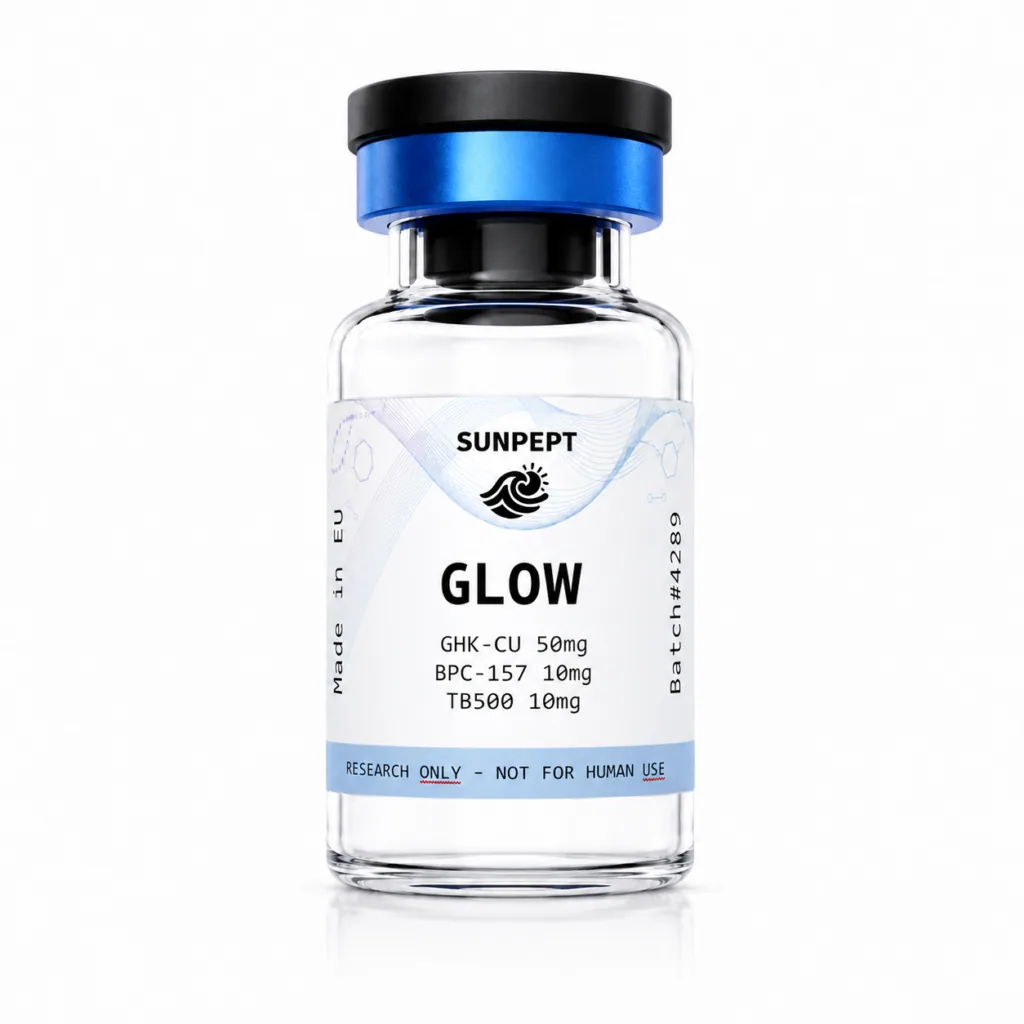
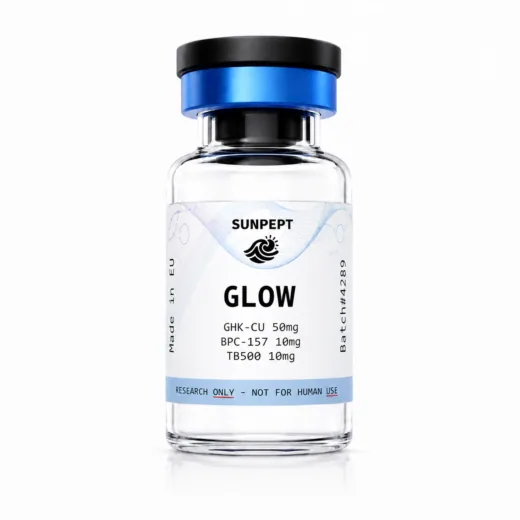
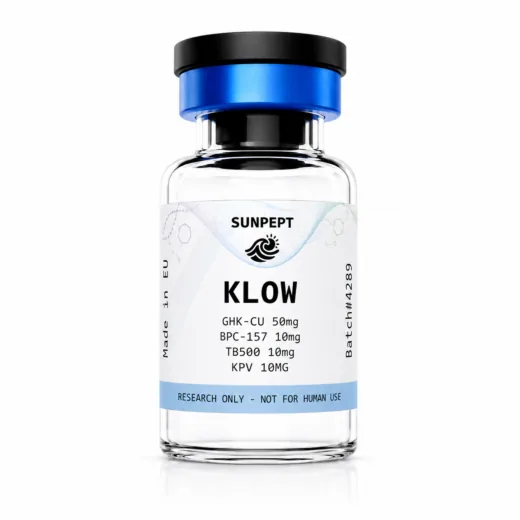
GLOW and KLOW are multi-component research compounds. The GLOW peptide combines GHK-Cu (50 mg), BPC-157 (10 mg), and TB-500 (10 mg) in one preparation with a total of 70 mg. The KLOW peptide contains the same three components plus the tripeptide KPV (10 mg), 80 mg in total. Both are intended exclusively for laboratory research.
The idea behind such combinations: in the literature, the individual components have been studied in different but thematically related model systems – extracellular matrix, angiogenesis, actin dynamics, and inflammatory signaling. A multi-component format makes it possible to look at such questions in parallel in one experimental setup.
This article explains the composition, the difference between GLOW and KLOW, the scientific context of each component, and the limits of the approach. Very important up front: there are no published studies on the combinations themselves – all cited findings concern single substances in preclinical models.
At a glance
- Compound class: lyophilized peptide combinations (multi-component research compounds)
- GLOW: GHK-Cu 50 mg + BPC-157 10 mg + TB-500 10 mg = 70 mg
- KLOW: GLOW components + KPV 10 mg = 80 mg
- Research context of the components: matrix/collagen models (GHK-Cu), angiogenesis signaling (BPC-157), actin binding (TB-500), inflammation models (KPV)
- State of the evidence: findings only on single substances, mostly preclinical; no studies on the combination
- Approval: none – Research Use Only
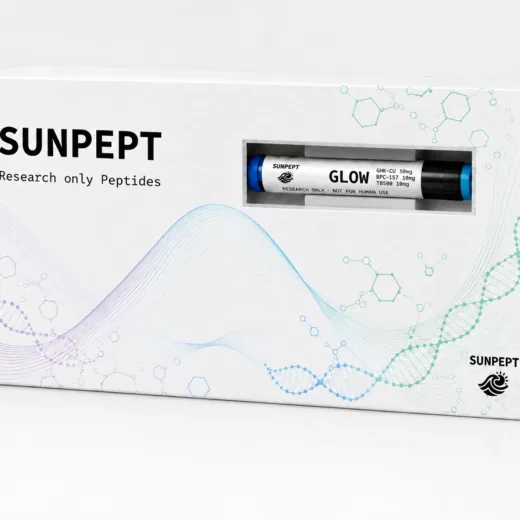
- Formats at SunPept: GLOW as Vial (lyophilized) and Pen (pre-dissolved) with Janoshik analysis reports; KLOW as Vial, analysis documentation on request
Composition: GLOW and KLOW compared
| Component | Type | GLOW | KLOW |
|---|---|---|---|
| GHK-Cu | Copper(II) complex of the tripeptide Gly-His-Lys | 50 mg | 50 mg |
| BPC-157 | Pentadecapeptide (15 amino acids) | 10 mg | 10 mg |
| TB-500 | Heptapeptide Ac-LKKTETQ (thymosin β4 fragment) | 10 mg | 10 mg |
| KPV | Tripeptide Lys-Pro-Val (α-MSH 11–13) | – | 10 mg |
| Total | 70 mg | 80 mg | |
| Formats | Vial and Pen | Vial |
GHK-Cu is the predominant component by quantity in both combinations. The other peptides are each included at 10 mg.
The components in their research context
GHK-Cu: matrix and collagen models
GHK (glycyl-L-histidyl-L-lysine) is a tripeptide that has been detected in human plasma, saliva, and urine and forms a complex with copper(II). Reviews by Pickart and colleagues describe that, in models, GHK influences both the synthesis and the breakdown of collagen and glycosaminoglycans as well as the activity of metalloproteinases and their inhibitors, and attracts immune and endothelial cells[2]. Another paper discusses GHK-Cu in light of gene expression data[1]. Note that both papers are narrative reviews by the same group of authors. More on this in the article GHK-Cu in skin research.
BPC-157: angiogenesis signaling
BPC-157 is a synthetic pentadecapeptide that has been described as a partial sequence of a gastric juice protein. Hsieh et al. (2017) reported increased VEGFR2 expression and activation of the VEGFR2–Akt–eNOS cascade in endothelial cells and a rat model[4]. The research group around Sikirić also describes findings in vascular and gastrointestinal rat models[3]. Controlled human studies are lacking. In detail: BPC-157: research overview.
TB-500: actin binding and cell migration
TB-500 corresponds to the central actin-binding region (amino acids 17–23, LKKTETQ) of the 43-amino-acid protein thymosin β4, N-terminally acetylated. Sosne et al. attributed activities in angiogenesis, wound, and migration models to this region[6]; Goldstein et al. summarize the biology of the full-length protein[5]. Findings on the protein cannot automatically be transferred to the fragment – details in the article TB-500 and thymosin β4.
KPV: inflammation models (KLOW only)
KPV is the C-terminal tripeptide of the melanocortin hormone α-MSH. Brzoska et al. describe that KPV shows inflammation-related activity in models without the hormone's pigment-related action[8]. Dalmasso et al. (2008) reported uptake via the peptide transporter PepT1 and inhibition of NF-κB and MAP kinase signaling in intestinal epithelial and immune cells, as well as findings in mouse colitis models[7]. More in the article KPV: research overview.
Why multi-component approaches? The research logic
In model systems, tissue responses are not isolated processes but an interplay of matrix remodeling, vascular response, cell migration, and inflammatory signaling. In the literature, each of the four components addresses a different one of these areas:
- Matrix models: collagen-, glycosaminoglycan-, and metalloproteinase-related endpoints (GHK-Cu)[2].
- Angiogenesis models: tube formation, CAM assay, ischemia models, VEGFR2 signaling (BPC-157)[4]; Tβ4-related angiogenesis models (TB-500 region)[6].
- Migration and cytoskeleton models: G-actin binding, cell migration (TB-500 region)[5][6].
- Inflammation models: NF-κB, MAPK, and cytokine endpoints (KPV)[7].
A combination format can be of interest for research questions in which several of these endpoints are to be measured at the same time. At the same time, it makes attribution more difficult: in a mixture, observed effects cannot readily be attributed to a single component. For mechanistic questions, single-substance controls are therefore usually needed in the experimental design.
Then there are the analytics: in a mixture, several peptides must be identified and quantified side by side, which is methodologically more demanding than for a single substance. Before you adopt a multi-component format in an experimental design, it is therefore worth looking at the available analysis reports and at the question of which component is actually relevant to your endpoints.
Important: no demonstrated synergy
There are no published studies that have investigated GLOW, KLOW, or comparable combinations of these four peptides. Statements about synergistic or additive effects are therefore not scientifically supported. GLOW and KLOW are research formats – not products with a proven effect.
GLOW vs. KLOW: which difference is relevant?
The only difference in composition is KPV. For research questions, this means:
- GLOW brings together components that have been studied in the literature mainly in the context of matrix, blood vessels, and cell migration.
- KLOW adds a component from inflammation and melanocortin research. This can be relevant for experimental designs that additionally measure inflammatory parameters such as NF-κB activity or cytokine profiles.
The two also differ in format: GLOW is available as a lyophilized Vial and as a pre-dissolved Pen, KLOW exclusively as a Vial. The differences between the two formats are explained in the article Vial vs. Pen.
“GLOW stack” and “KLOW stack”: what is behind the search term
In forums and on social media, peptide combinations are often referred to as a “stack” – usually in connection with use in humans. We deliberately do not cater to this framing. Objectively speaking, GLOW and KLOW are predefined research combinations with a fixed quantity ratio, intended for laboratory investigations. There are no scientifically founded usage protocols or combination recommendations for humans or animals, and SunPept does not provide such information.
Safety data and approval status
No safety data exist for the combinations. For the individual components: no controlled human studies have been published on BPC-157, TB-500, or KPV; the available data come from cell and animal models[3][7]. For full-length thymosin β4 – not TB-500 – specific formulations have been tested in early clinical trials[5]. None of the components is approved as a medicinal product.
Relevant for sport: the WADA Prohibited List expressly names BPC-157 (category S0) as well as thymosin β4 and its derivatives such as TB-500 (category S2). Details can be found in the individual articles on BPC-157 and TB-500.
Sourcing for research
- GLOW Vial – lyophilized, 70 mg total; Janoshik analysis reports linked.
- GLOW Pen – pre-dissolved; Janoshik analysis reports linked.
- KLOW Vial – lyophilized, 80 mg total; analysis documentation on request.
You'll find all available reports collected at Test reports. Shipping is within the EU from the Czech Republic, payment by prepayment; at checkout, you confirm use for research purposes only. Current prices are shown on the product pages. Whether and under what conditions purchasing is permissible depends on the substance, country, and intended use – a neutral overview is given in the article Research peptides and the legal situation (not legal advice). Further topics are collected in the section Tissue Research.
Frequently asked questions
What is the GLOW peptide?
GLOW is a multi-component research compound made up of GHK-Cu (50 mg), BPC-157 (10 mg), and TB-500 (10 mg), 70 mg in total. The components have been studied individually in preclinical models of matrix biology, angiogenesis signaling, and actin dynamics. At SunPept, GLOW is available as a Vial and as a Pen, each with a Janoshik analysis report.
What is the KLOW peptide?
KLOW contains the same three components as GLOW plus KPV (10 mg), 80 mg in total. KPV is the C-terminal tripeptide of α-MSH and is studied in preclinical inflammation models. At SunPept, KLOW is available as a lyophilized Vial; analysis documentation is available on request.
What is the difference between GLOW and KLOW?
In terms of composition, KLOW differs only by the additional component KPV. GLOW comprises peptides from matrix, vascular, and migration research; KLOW adds a component from inflammation and melanocortin research. In terms of format, GLOW is available as a Vial and Pen, KLOW only as a Vial.
Has a synergistic effect of the combination been demonstrated?
No. There are no published studies on GLOW, KLOW, or comparable combinations of these peptides. All cited findings concern single substances in cell and animal models. Statements about synergistic or additive effects are therefore not scientifically supported.
Is there dosing information for GLOW or KLOW?
No. GLOW and KLOW are Research Use Only substances without approval. There are no usage, dosing, or combination recommendations. Concentrations and experimental conditions are defined solely by the respective research protocol; SunPept provides no information on this.
What does “GLOW stack” mean?
“Stack” is a forum term for peptide combinations, usually referring to use in humans. GLOW and KLOW, by contrast, are predefined research combinations with a fixed quantity ratio for laboratory investigations. There are no usage protocols for them, and SunPept does not provide any.
Sources
- Pickart L, Margolina A. Regenerative and Protective Actions of the GHK-Cu Peptide in the Light of the New Gene Data. Int J Mol Sci. 2018;19(7):1987. doi:10.3390/ijms19071987
- Pickart L, Vasquez-Soltero JM, Margolina A. GHK Peptide as a Natural Modulator of Multiple Cellular Pathways in Skin Regeneration. Biomed Res Int. 2015;2015:648108. doi:10.1155/2015/648108
- Sikiric P, Rucman R, Turkovic B, et al. Curr Pharm Des. 2018;24(18):1990-2001. doi:10.2174/1381612824666180608101119
- Hsieh MJ, Liu HT, Wang CN, et al. J Mol Med (Berl). 2017;95(3):323-333. doi:10.1007/s00109-016-1488-y
- Goldstein AL, Hannappel E, Sosne G, Kleinman HK. Thymosin β4: a multi-functional regenerative peptide. Basic properties and clinical applications. Expert Opin Biol Ther. 2012;12(1):37-51. doi:10.1517/14712598.2012.634793
- Sosne G, Qiu P, Goldstein AL, Wheater M. Biological activities of thymosin beta4 defined by active sites in short peptide sequences. FASEB J. 2010;24(7):2144-2151. doi:10.1096/fj.09-142307
- Dalmasso G, Charrier-Hisamuddin L, Nguyen HT, Yan Y, Sitaraman S, Merlin D. PepT1-mediated tripeptide KPV uptake reduces intestinal inflammation. Gastroenterology. 2008;134(1):166-178. doi:10.1053/j.gastro.2007.10.026
- Brzoska T, Luger TA, Maaser C, Abels C, Böhm M. Endocr Rev. 2008;29(5):581-602. doi:10.1210/er.2007-0027
Research Use Only: GLOW and KLOW are intended exclusively for in vitro research and laboratory investigations. They are not medicinal products, foods, or cosmetics and are not intended for human or veterinary use. Learn more at Research Use Only.
The compound from this article in the shop
Vial (lyophilized) or Pen (pre-dissolved), Janoshik analysis reports linked where available. Shipped from the EU to 25 countries. For research purposes only.