GHK-Cu Peptide: Copper Tripeptide, Structure, and State of Research
GHK-Cu is the copper complex of the tripeptide Gly-His-Lys. Structure, discovery, preclinical findings, cosmetics context, and safety data – objective and with primary sources.

GHK-Cu is a copper complex of the tripeptide glycyl-L-histidyl-L-lysine (Gly-His-Lys), which occurs naturally in human plasma. The GHK-Cu peptide binds copper(II) ions with high affinity and has been studied since the 1970s, mainly in cell culture and animal models, in relation to matrix biology, gene expression, and copper homeostasis.
The factor was first described in 1973 by Loren Pickart and Martin Thaler, who isolated it from human serum[1]. It later emerged that the small peptide complexes copper and can influence its uptake into cultured cells[2]. Since then, GHK-Cu has become one of the most frequently cited copper peptides in matrix and dermatology research – and at the same time a common ingredient in cosmetic products.
In this article, you'll get an objective overview: structure and copper binding, the most important experimental findings, the classification of the cosmetics context, the available safety data, and the supply formats for research institutions. Where data are lacking or only weak, we say so explicitly.
At a glance
- Compound class: Tripeptide–copper complex (metallopeptide); listed in cosmetics under the INCI name “Copper Tripeptide-1.”
- Sequence: Gly-His-Lys (GHK), three amino acids.
- Molecular mass: GHK 340.38 g/mol; copper complex approx. 402.9 g/mol according to PubChem (CAS 89030-95-5)[9].
- Discovery: 1973 by Pickart and Thaler from human serum[1].
- Copper binding: via the amino group of glycine, an amide nitrogen, and the imidazole ring of histidine[3].
- State of research: predominantly in vitro and animal data; controlled human studies are rare.
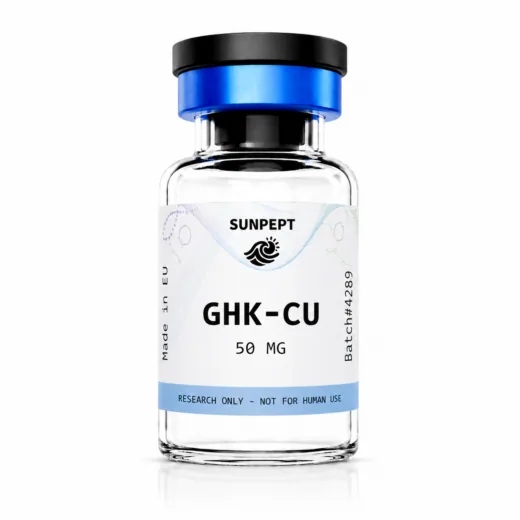
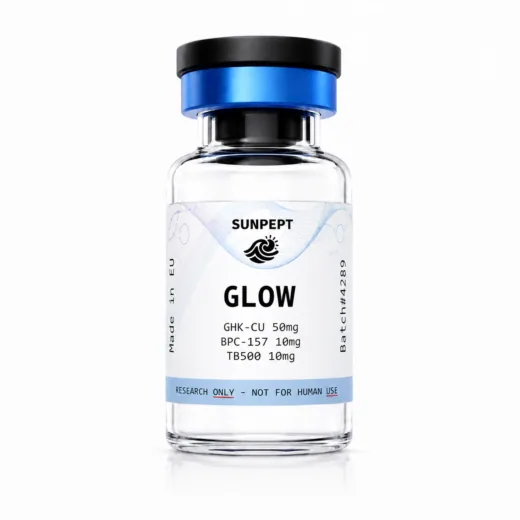
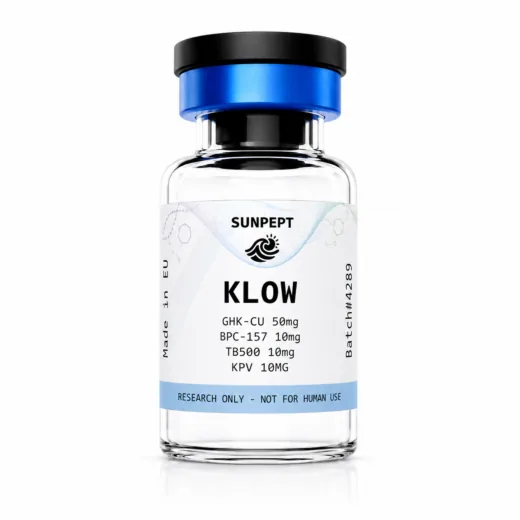
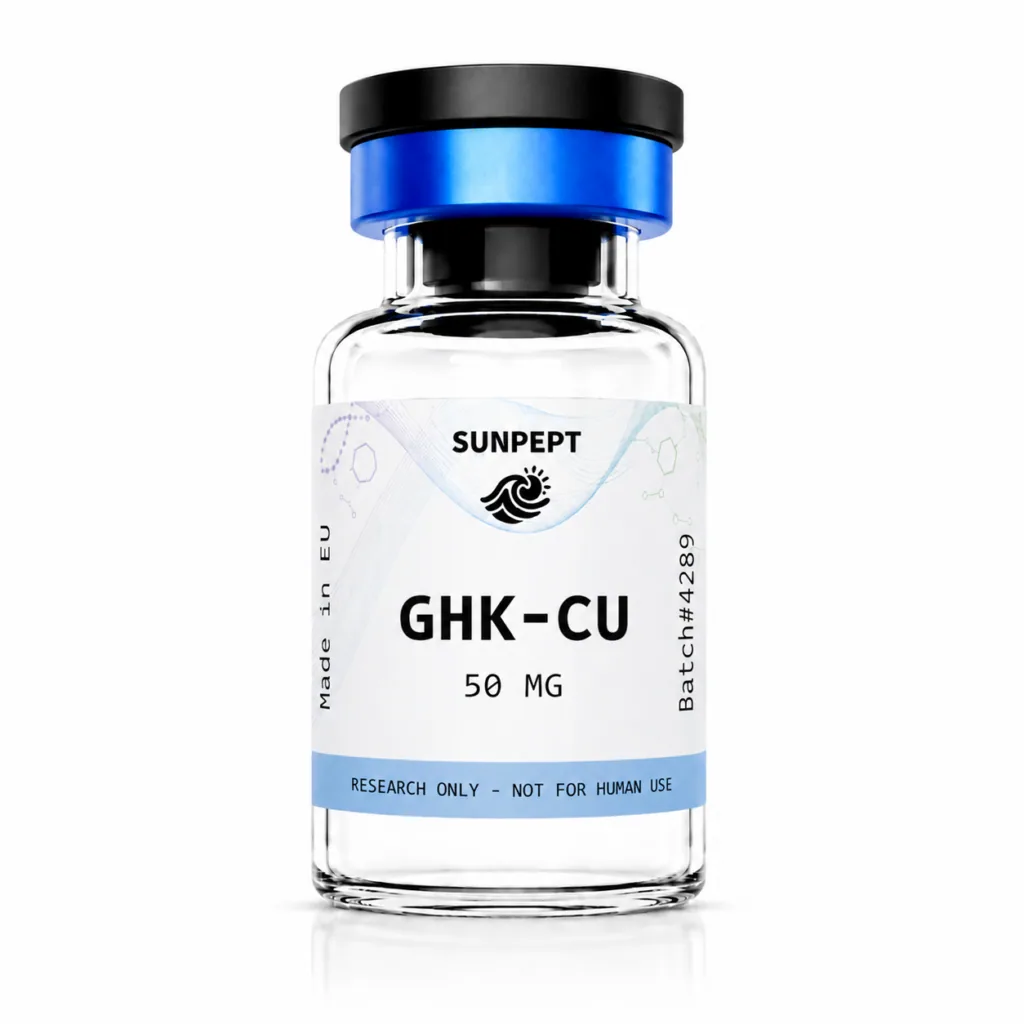
- Available at SunPept: lyophilized Vial with 50 mg; also a component of the GLOW and KLOW combinations.
What is GHK-Cu? Structure and copper binding
GHK consists of only three amino acids: glycine at the N-terminus, histidine in the middle, and lysine at the C-terminus. Only by binding a copper(II) ion does GHK-Cu form – the complex to which most of the literature refers. Pickart describes the copper affinity of GHK as similar to that of the copper transport site of albumin, the most important transport protein in blood plasma[4].
How does GHK bind the copper ion?
A structural study by Hureau and colleagues (2011) characterized Cu(II)-GHK using X-ray crystallography and several spectroscopic methods (EPR, X-ray absorption, NMR)[3]. They reported that in solution, a monomeric complex is present in which copper is coordinated via three nitrogen atoms – the free amino group, an amide nitrogen, and the imidazole nitrogen of histidine. The fourth coordination site is occupied by an easily exchangeable ligand; in the solid state, the complex forms a dimer. This open position explains why GHK-Cu can form ternary complexes with other molecules and exchange copper relatively quickly.
Redox behavior
In the same study, the complex proved largely inert under moderate redox conditions. At strongly negative potentials, however, Cu(II)-GHK could be reduced to Cu(I), releasing the copper ion[3]. This is relevant for laboratory work: the copper center is functionally central but sensitive to reducing and oxidizing conditions.
Discovery: from serum factor to copper peptide
The 1973 paper by Pickart and Thaler described a tripeptide from human serum that prolonged the survival of normal liver cells and stimulated the growth of hepatoma cells in cell culture[1]. At the time, the focus was therefore on liver cell models, not on skin.
In 1980, a paper in Nature established the link to copper[2]: During isolation, the peptide co-enriched with approximately equimolar amounts of copper. At nanomolar concentrations, it triggered very different responses in different cell systems – ranging from growth stimulation to toxicity. The authors reported that GHK readily forms complexes with copper(II) and increases copper uptake into cultured hepatoma cells. This led to the hypothesis that GHK might act as a copper transport factor.
Another frequently cited finding: the sequence Gly-His-Lys occurs in the α2(I) chain of type I collagen. Maquart and colleagues discussed that the tripeptide could be released during proteolytic degradation of collagen[5]. This is a hypothesis, not a demonstrated physiological mechanism.
Mechanism of action: what research shows
The search query “GHK-Cu effects” usually aims at specific effects. Scientifically, it is only correct to describe which endpoints were investigated in which models. Most data come from cell cultures and animal models; conclusions for humans cannot be derived from them.
Collagen and matrix synthesis in fibroblasts
Maquart et al. (1988) investigated GHK-Cu in fibroblast cultures and reported increased collagen synthesis that began at very low, nanomolar concentrations and was independent of any change in cell number[5]. Review articles also describe GHK as reportedly modulating both the synthesis and the degradation of collagen and glycosaminoglycans, as well as the activity of matrix metalloproteinases and their inhibitors[7]. This refers to an influence on the balance of matrix remodeling, not a one-sided “building” effect.
Fibroblasts after irradiation, and growth factors
Pollard et al. (2005) cultured human dermal fibroblasts derived from previously irradiated tissue under serum-free conditions[6]. In the GHK-Cu-treated cultures, the population doubling time was shorter than in untreated controls; in addition, higher production of the growth factors bFGF and VEGF was measured early after exposure. This is a purely in vitro model with a small data set.
Gene expression data
A particularly frequently cited statement is that GHK influences the expression of thousands of genes. In review articles based on gene expression data, Pickart and colleagues describe that GHK may up- or downregulate at least 4,000 human genes[7][8]. Important for context: such expression profiles show associations at the RNA level in cell lines. They demonstrate neither that the changes are functionally meaningful nor that they occur in the same form in a living organism. In addition, a large part of the review literature comes from the research group of the discoverer himself – independent replications are essential for a robust assessment.
| Model | Endpoint investigated | Reported finding | Source |
|---|---|---|---|
| Liver cell culture (1973) | Cell survival, growth | prolonged survival of normal cells, growth of hepatoma cells | [1] |
| Hepatoma cells (1980) | Copper uptake | increased copper uptake with GHK-Cu | [2] |
| Fibroblast culture (1988) | Collagen synthesis | increase without change in cell number | [5] |
| Irradiated human fibroblasts (2005) | Cell division, bFGF, VEGF | shorter doubling time, early increase in bFGF/VEGF | [6] |
| Expression data (reviews 2015/2018) | Gene expression | changes in ≥ 4,000 genes described | [7], [8] |
GHK-Cu in cosmetics: serums, creams, and the research context
If you search for “GHK-Cu serum” or “copper peptide cream,” you will quickly come across numerous cosmetic products. GHK-Cu is common there as an ingredient under the INCI name “Copper Tripeptide-1.” This is first and foremost a statement about market prevalence – not about proven efficacy.
Pickart’s review articles also refer to studies using cosmetic formulations[7]. These studies differ widely in design, formulation, number of participants, and measurement methods, and many are small or have not been independently replicated. For a scientific assessment, the following therefore applies: cosmetic products are subject to their own legal framework, their claims refer to the respective finished product, and they are not comparable to lyophilized research material. SunPept offers GHK-Cu exclusively as a research chemical – not as a cosmetic.
For a topical overview of skin research with peptides, see the research area Dermatology.
Safety data from studies
The search query “GHK-Cu side effects” can only be answered to a limited extent on the basis of the literature. Systematically collected safety data from controlled human studies on the isolated peptide are not available in the literature reviewed here. The following findings are nevertheless relevant for context:
- Concentration-dependent effects in cell culture: Pickart et al. reported in 1980 that, depending on the cell system, the peptide triggered responses ranging from growth stimulation to toxicity[2].
- Copper release: Under reducing conditions, Cu(II)-GHK can be reduced to Cu(I) and the copper released[3]. Free copper is redox-active; this matters for experimental design and controls.
- Data situation: Most available data come from in vitro and animal models. No conclusions about tolerability in humans can be drawn from them.
For research projects, this means: controls with free copper and with copper-free GHK help to separate peptide-mediated from metal-mediated effects.
State of research and open questions
After roughly five decades of research, GHK-Cu is well described biochemically but still incompletely understood biologically. Open questions include:
- whether the GHK levels described in plasma, which according to the review literature decline with age[7], are physiologically relevant,
- what proportion of the described effects is due to the peptide and what proportion to the bound copper,
- how stable the complex is in complex biological media, where albumin and other copper binders compete,
- and whether the gene expression findings can be confirmed in independent, functional experiments.
Precisely because of these open questions, GHK-Cu is well suited as a model compound for studies on copper homeostasis, metal–peptide coordination, and matrix remodeling in cell culture.
Sourcing for research
SunPept carries GHK-Cu as a GHK-Cu Vial with 50 mg in lyophilized form. Analysis documentation for this product is available on request. For projects investigating several peptides in one setup, GHK-Cu is also a component of the combinations GLOW (GHK-Cu, BPC-157, and TB-500; Janoshik analysis reports linked on the product page) and KLOW (GLOW plus KPV; analysis documentation on request).
Shipping is from the Czech Republic to EU countries; payment is by prepayment, and at checkout you confirm exclusive use for research purposes. Current prices can be found directly on the product page. Whether purchase is permitted in your country depends on the substance and intended use – our article provides a neutral overview of the legal status of research peptides offers a neutral overview (not legal advice).
Frequently asked questions
What is GHK-Cu?
GHK-Cu is the copper(II) complex of the tripeptide glycyl-L-histidyl-L-lysine. The peptide occurs naturally in human plasma and was described in 1973 by Pickart and Thaler. In research, it serves mainly as a model substance for copper binding, matrix biology, and gene expression analyses in cell and animal models.
Is GHK-Cu a peptide?
Yes. GHK is a tripeptide made up of glycine, histidine, and lysine, making it one of the smallest biologically studied peptides. Binding a copper ion produces the metal complex GHK-Cu. The term “copper peptide” usually refers to exactly this complex.
What is the difference between GHK and GHK-Cu?
GHK refers to the copper-free tripeptide with a molecular mass of around 340 g/mol. GHK-Cu is the complex with a bound copper(II) ion, around 403 g/mol according to PubChem. Because GHK binds copper with high affinity, in biological media it is often present partly as a copper complex.
Is there dosing information for GHK-Cu?
No. At SunPept, GHK-Cu is offered exclusively for research (Research Use Only), and we provide no usage or dosing recommendations. Concentrations and experimental parameters are defined by the respective scientific protocol, which is independently planned, documented, and overseen by the responsible research institution.
What safety data are available on GHK-Cu?
Controlled human studies with systematically recorded adverse events on the isolated peptide are lacking in the literature reviewed. Cell culture data show concentration- and cell-type-dependent effects up to and including toxicity, and under reducing conditions copper can be released from the complex. No reliable conclusions about tolerability in humans can be drawn from this.
Where can I obtain GHK-Cu for research?
SunPept offers GHK-Cu as a lyophilized Vial with 50 mg; it is also a component of the GLOW and KLOW combinations. Shipping is from the Czech Republic to EU countries against prepayment, with confirmation of the research purpose at checkout. Whether purchasing is permissible depends on the country, substance, and intended use.
Sources
- Pickart L, Thaler MM. Tripeptide in human serum which prolongs survival of normal liver cells and stimulates growth in neoplastic liver. Nature New Biology. 1973;243(124):85–87. PMID: 4349963
- Pickart L, Freedman JH, Loker WJ, Peisach J, Perkins CM, Stenkamp RE, Weinstein B. Growth-modulating plasma tripeptide may function by facilitating copper uptake into cells. Nature. 1980;288(5792):715–717. doi:10.1038/288715a0
- Hureau C, Eury H, Guillot R, Bijani C, Sayen S, Solari PL, Guillon E, Faller P, Dorlet P. X-ray and solution structures of Cu(II) GHK and Cu(II) DAHK complexes: influence on their redox properties. Chemistry – A European Journal. 2011;17(36):10151–10160. doi:10.1002/chem.201100751
- Pickart L. The human tri-peptide GHK and tissue remodeling. Journal of Biomaterials Science, Polymer Edition. 2008;19(8):969–988. doi:10.1163/156856208784909435
- Maquart FX, Pickart L, Laurent M, Gillery P, Monboisse JC, Borel JP. Stimulation of collagen synthesis in fibroblast cultures by the tripeptide-copper complex glycyl-L-histidyl-L-lysine-Cu2+. FEBS Letters. 1988;238(2):343–346. doi:10.1016/0014-5793(88)80509-x
- Pollard JD, Quan S, Kang T, Koch RJ. Effects of copper tripeptide on the growth and expression of growth factors by normal and irradiated fibroblasts. Archives of Facial Plastic Surgery. 2005;7(1):27–31. doi:10.1001/archfaci.7.1.27
- Pickart L, Vasquez-Soltero JM, Margolina A. GHK peptide as a natural modulator of multiple cellular pathways in skin regeneration. BioMed Research International. 2015;2015:648108. doi:10.1155/2015/648108
- Pickart L, Margolina A. Regenerative and protective actions of the GHK-Cu peptide in the light of the new gene data. International Journal of Molecular Sciences. 2018;19(7):1987. doi:10.3390/ijms19071987
- National Center for Biotechnology Information. PubChem Compound Summary for CID 71587328, Prezatide copper. pubchem.ncbi.nlm.nih.gov/compound/71587328
Research Use Only: SunPept offers GHK-Cu exclusively for scientific laboratory research. The product is not a medicinal product, not a cosmetic, and not intended for use in humans or animals. This article is provided for scientific information and contains no health, use, or dosage recommendations.
The compound from this article in the shop
Vial (lyophilized) or Pen (pre-dissolved), Janoshik analysis reports linked where available. Shipped from the EU to 25 countries. For research purposes only.