NAD+: Coenzyme, Biosynthesis, Sirtuins, and What Research Shows
What is NAD+? Structure, biosynthesis, sirtuins, PARPs and CD38, the age-associated NAD+ decline described in studies, and how it differs from NMN and NR – factual, with sources.

NAD+ (nicotinamide adenine dinucleotide) is a coenzyme found in all living cells. As a redox partner, it transfers electrons in energy metabolism and at the same time serves as a substrate for enzymes such as sirtuins, PARPs, and CD38. Because cellular NAD+ levels decline with age in studies, NAD+ is a central topic of longevity research.
Contrary to common assumption, NAD+ is not a peptide but a dinucleotide: two nucleotides linked by a phosphate bridge, one with nicotinamide and one with adenine. The search query “NAD+ peptide” shows how often NAD+ is mentioned in the same breath as research peptides – biochemically, however, it belongs to a different substance class.
This article explains how NAD+ is formed and consumed, which enzyme families depend on it, what studies report about age-associated changes, and how NAD+ differs from its precursors NMN and NR. All statements are supported by review articles and primary studies.
At a glance
- Compound class: Dinucleotide coenzyme (not a peptide).
- Molecular formula and mass: C21H27N7O14P2, 663.4 g/mol (PubChem)[8].
- Function 1: Redox coenzyme, electron carrier alternating with NADH[1].
- Function 2: Co-substrate for sirtuins, poly(ADP-ribose) polymerases (PARPs), and CD38[2].
- Biosynthesis: including via the salvage pathway, in which NAMPT is described as the rate-limiting enzyme[3].
- Research focus: age-associated NAD+ decline in animal models and human tissue[2][5].
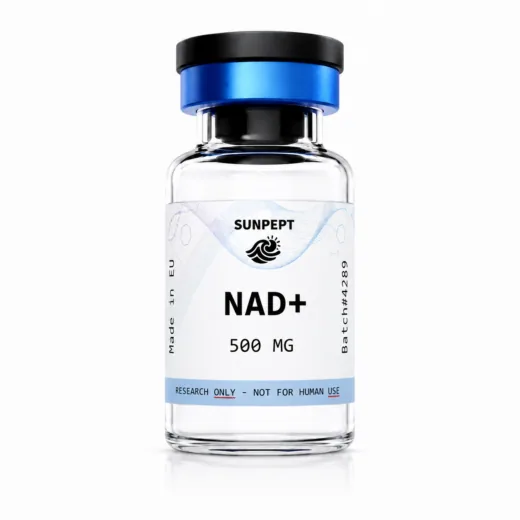
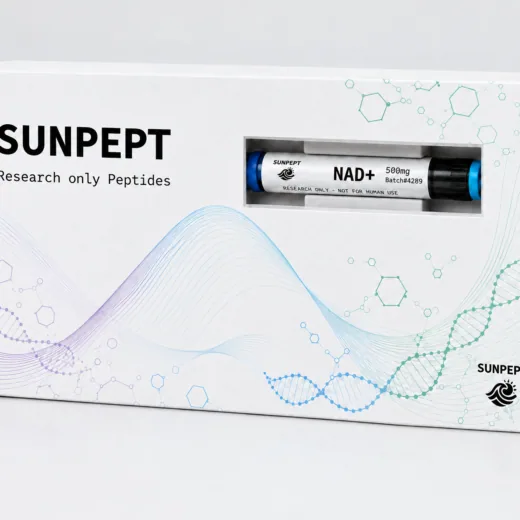
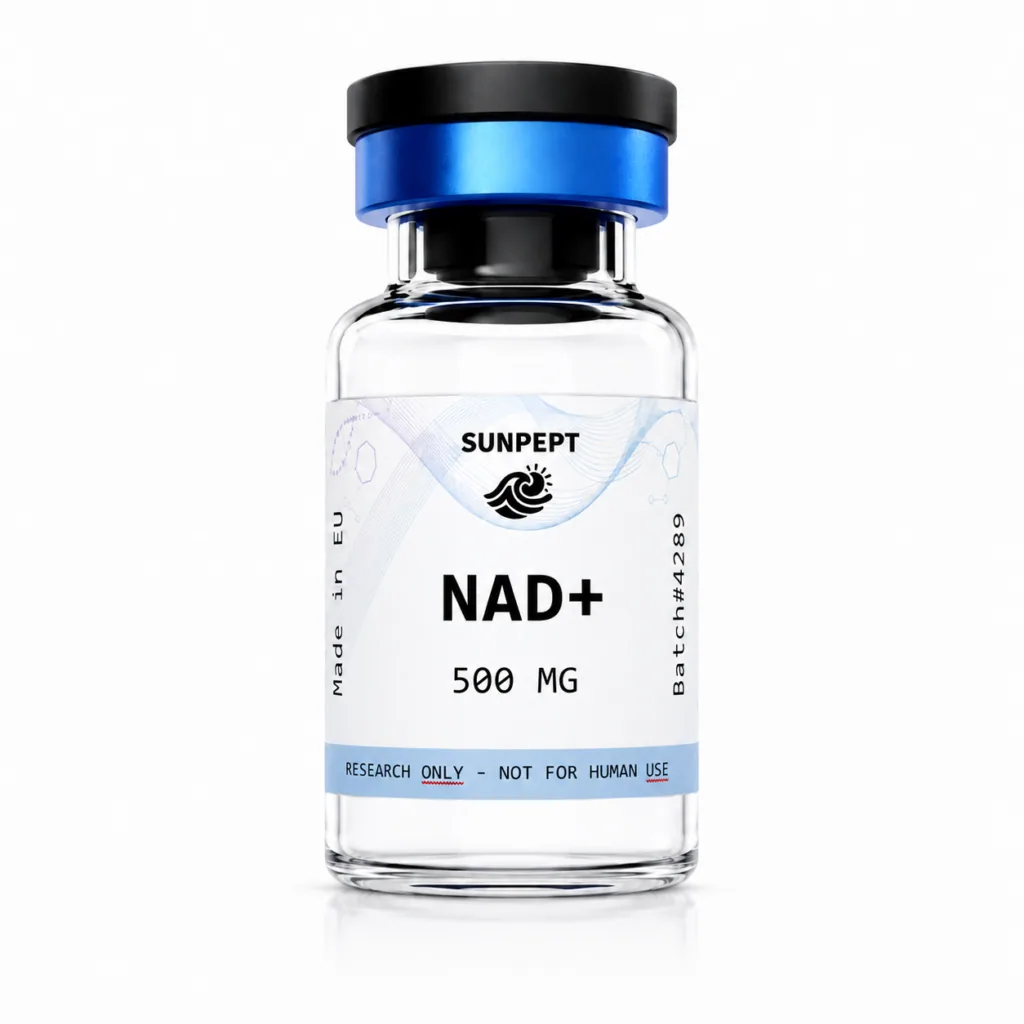
- Available at SunPept: Vial 500 mg and 1000 mg (lyophilized), Pen 500 mg (pre-dissolved).
What is NAD+? Structure and basic function
NAD+ consists of a nicotinamide ribonucleotide and an adenosine monophosphate linked by a pyrophosphate bond. The “+” denotes the oxidized form with a positively charged pyridinium ring. When NAD+ accepts a hydride ion, the reduced form NADH is formed.
NAD+ as a redox coenzyme
In its classic role, NAD+ alternates between oxidized and reduced forms and thus transports electrons from one reaction to the next – for example in glycolysis, the citric acid cycle, and the feeding of electrons into the mitochondrial respiratory chain[1]. In these reactions, NAD+ is not consumed but merely converted; the ratio of NAD+ to NADH is regarded as an important indicator of the cellular redox state.
NAD+ as a signaling molecule
Since the 2000s, a second role has come to the fore: NAD+ is a co-substrate for enzymes that cleave the molecule, releasing nicotinamide in the process. Rajman and colleagues therefore describe NAD+ as a signaling molecule whose levels fluctuate with factors such as food intake, physical activity, and time of day[7]. Unlike in redox reactions, NAD+ is actually consumed here and must be regenerated.
NAD+ biosynthesis: de novo, Preiss-Handler, and salvage
Mammalian cells have several pathways for producing NAD+. Review articles essentially distinguish three[2][4]:
| Pathway | Starting material | Key enzymes (selection) |
|---|---|---|
| De novo synthesis | Tryptophan (via the kynurenine pathway) | multistep, including QPRT |
| Preiss-Handler pathway | Nicotinic acid (NA) | NAPRT, NMNAT, NADS |
| Salvage pathway | Nicotinamide (NAM), nicotinamide riboside (NR) | NAMPT, NRK, NMNAT |
The salvage pathway and NAMPT
Quantitatively, the salvage pathway dominates in many tissues: the nicotinamide released in sirtuin, PARP, and CD38 reactions is converted via NAMPT to nicotinamide mononucleotide (NMN) and then via NMNAT back to NAD+. In 2004, Revollo, Grimm, and Imai showed in mouse fibroblasts that NAMPT is the rate-limiting step of this pathway: an increased NAMPT dosage raised cellular NAD+ content and the transcriptional activity of the sirtuin Sir2α, whereas an increased NMNAT dosage did not[3]. This experimentally demonstrated a direct link between NAD+ biosynthesis and sirtuin function.
Mechanism of action: sirtuins, PARPs, and CD38
Scientifically, the question of the “effect” of NAD+ can be framed as a question about the enzymes that use NAD+. Three families are at the center[1][2]:
Sirtuins (SIRT1–7)
Sirtuins are NAD+-dependent deacylases that remove acetyl and other acyl groups from proteins, including histones, transcription factors, and mitochondrial enzymes. Because they require NAD+ as a co-substrate, their activity depends on NAD+ availability. The seven mammalian sirtuins differ in cellular compartment and substrate spectrum: SIRT1 is predominantly nuclear, while SIRT3 to SIRT5 are mitochondrial.
PARPs
Poly(ADP-ribose) polymerases, in particular PARP1, transfer ADP-ribose units from NAD+ to target proteins and are involved in the detection and repair of DNA damage. When strongly activated, PARPs can consume substantial amounts of NAD+. Massudi et al. investigated this relationship in human tissue (see below)[5].
CD38
CD38 is an NADase that converts NAD+ into products including ADP-ribose and cyclic ADP-ribose. In 2016, Camacho-Pereira et al. reported in mouse models that CD38 expression and activity increase with age and that CD38 is required for the age-associated NAD+ decline and the associated mitochondrial dysfunction – mediated in part via SIRT3[6]. The authors also identified CD38 as the main enzyme for the degradation of the precursor NMN in vivo.
Age-associated NAD+ decline: what studies report
Review articles describe a decline in NAD+ levels with age for several model organisms, including rodents and humans[2]. In 2015, Verdin summarized that cellular NAD+ concentrations change with age and that modulating NAD+ consumption or production in animal models can influence lifespan and healthspan[1].
Human tissue: the study by Massudi et al.
One of the frequently cited human studies analyzed skin samples from 49 individuals aged 0 to 77 years, which had been collected during unrelated surgical procedures[5]. A clear negative correlation between NAD+ content and age was reported in men and women. In men, PARP activity increased with age and correlated inversely with NAD+ content; in women, these relationships were less pronounced. The study is correlational and limited to one tissue, but it provides data from human material rather than from animal models.
Mechanistic explanations
- Increased consumption: greater PARP activity due to increasing DNA damage[5] and rising CD38 activity[6].
- Altered biosynthesis: among other things, reduced performance of the NAMPT-dependent salvage pathway is discussed[4].
- Open questions: Covarrubias et al. emphasize that it is still unclear how NAD+ levels are regulated with age, whether restoring them is safe, and whether it would actually provide benefits in aging humans[2].
You can find more background on this research field in the section Longevity Research.
NAD+ vs. NMN and NR: the precursors compared
In the research literature, in addition to NAD+ itself, two precursors in particular are investigated: nicotinamide mononucleotide (NMN) and nicotinamide riboside (NR). Yoshino, Baur, and Imai describe that the two intermediates differ in their behavior and that their fate depends on the tissue distribution of biosynthetic enzymes, on nucleotidases, and on putative transporters; pharmacokinetics and metabolic pathways are still the subject of intensive research[4].
| Molecule | Position in metabolism | Particularity for research |
|---|---|---|
| NAD+ | End product, active coenzyme | large, charged dinucleotide; uptake from the extracellular space is under discussion |
| NMN | direct precursor (via NMNAT to NAD+) | degraded by CD38, among others[6] |
| NR | precursor (via NRK to NMN) | part of the salvage network[4] |
| Nicotinamide (NAM) | degradation product and recycling substrate | substrate of NAMPT[3] |
Rajman et al. have summarized the in vivo evidence on NAD-raising molecules in animal models[7]. These data concern laboratory animals; the comparison is purely biochemical and is not a statement about dietary supplements or their benefits. For many research questions – such as enzyme kinetics, sirtuin assays, or stability studies – NAD+ itself is the relevant reference substance.
“NAD+ infusion”: putting the search query in context
A large proportion of search queries about NAD+ relate to infusions. To be clear: SunPept’s NAD+ is intended exclusively for research (Research Use Only). We provide no information on infusions, use in humans, dosages, or preparation and dilution steps. Offers of such applications fall within an entirely different legal and medical framework and are not the subject of this article.
Safety data from studies
For NAD+ as a research chemical, there are no safety data that could be transferred to use in humans. The reviews cited here point out that key questions remain open: Covarrubias et al. explicitly name the question of whether restoring NAD+ levels is safe and would provide benefits in aging humans as unresolved[2]. Yoshino et al. point out that it is unclear whether preclinical results are transferable to humans at all[4]. Specific adverse events from controlled studies with NAD+ itself are not described in the sources reviewed.
Sourcing for research
SunPept offers NAD+ as a lyophilized NAD+ Vial with 500 mg or 1000 mg and as a pre-dissolved NAD+ Pen with 500 mg . The Janoshik analysis reports are linked on the product pages. The advantages and disadvantages of the two formats for laboratory workflows are explained in our article Vial vs. Pen.
Shipping is from the Czech Republic to EU countries; payment is by prepayment, and at checkout you confirm exclusive use for research purposes. Current prices are listed on the product pages. Whether obtaining it is permitted in your country depends on the substance and intended use – our article provides a neutral overview of the legal situation of research compounds offers a neutral overview (not legal advice).
Frequently asked questions
What is NAD+, simply explained?
NAD+ is a coenzyme found in every living cell. It transports electrons in metabolic reactions, for example in glycolysis and the respiratory chain, and is also consumed as a substrate by enzymes such as sirtuins, PARPs, and CD38. Chemically, it is a dinucleotide made up of a nicotinamide nucleotide and an adenine nucleotide.
Is NAD+ a peptide?
No. NAD+ is a dinucleotide and does not consist of amino acids. It is often mentioned together with research peptides because it is also investigated in longevity research and offered in similar formats, such as Vial or Pen. Biochemically, however, it belongs to the group of nucleotide coenzymes.
What is the difference between NAD+ and NADH?
NAD+ is the oxidized form and NADH the reduced form of the same coenzyme. In metabolic reactions, NAD+ accepts electrons and thereby becomes NADH, which passes these electrons on, for example to the respiratory chain. In research, the ratio of the two forms is regarded as an indicator of a cell’s redox state.
Does NAD+ decline with age?
Review articles describe an age-associated decline in NAD+ in several model organisms, including rodents and humans. In a study of human skin samples, NAD+ content correlated negatively with age. Increased consumption by PARPs and CD38 and altered biosynthesis are discussed as causes.
Is there dosage information for NAD+?
No. SunPept offers NAD+ exclusively for research (Research Use Only), and we provide no information on dosage, infusion, or any other use. Concentrations and experimental parameters are defined by the respective scientific protocol, which is planned by and the responsibility of the research institution in charge.
What is the difference between NAD+, NMN, and NR?
NMN and NR are precursors from which cells can form NAD+ via the salvage pathway. NR is phosphorylated to NMN, and NMN is then converted to NAD+. NAD+ is the actual coenzyme. According to the review literature, how the precursors are metabolized in different tissues is still the subject of intensive research.
In which formats is NAD+ available at SunPept?
NAD+ is available as a lyophilized Vial with 500 mg or 1000 mg and as a pre-dissolved Pen with 500 mg. The Janoshik analysis reports are linked on the product pages. Shipping is from the Czech Republic to EU countries against prepayment, with confirmation of the research purpose at checkout.
Sources
- Verdin E. NAD+ in aging, metabolism, and neurodegeneration. Science. 2015;350(6265):1208–1213. doi:10.1126/science.aac4854
- Covarrubias AJ, Perrone R, Grozio A, Verdin E. NAD+ metabolism and its roles in cellular processes during ageing. Nature Reviews Molecular Cell Biology. 2021;22(2):119–141. doi:10.1038/s41580-020-00313-x
- Revollo JR, Grimm AA, Imai S. The NAD biosynthesis pathway mediated by nicotinamide phosphoribosyltransferase regulates Sir2 activity in mammalian cells. Journal of Biological Chemistry. 2004;279(49):50754–50763. doi:10.1074/jbc.M408388200
- Yoshino J, Baur JA, Imai SI. Cell Metabolism. 2018;27(3):513–528. doi:10.1016/j.cmet.2017.11.002
- Massudi H, Grant R, Braidy N, Guest J, Farnsworth B, Guillemin GJ. Age-associated changes in oxidative stress and NAD+ metabolism in human tissue. PLoS ONE. 2012;7(7):e42357. doi:10.1371/journal.pone.0042357
- Camacho-Pereira J, Tarragó MG, Chini CCS, Nin V, Escande C, Warner GM, Puranik AS, Schoon RA, Reid JM, Galina A, Chini EN. CD38 dictates age-related NAD decline and mitochondrial dysfunction through an SIRT3-dependent mechanism. Cell Metabolism. 2016;23(6):1127–1139. doi:10.1016/j.cmet.2016.05.006
- Rajman L, Chwalek K, Sinclair DA. Cell Metabolism. 2018;27(3):529–547. doi:10.1016/j.cmet.2018.02.011
- National Center for Biotechnology Information. PubChem Compound Summary for CID 5892, Nicotinamide adenine dinucleotide. pubchem.ncbi.nlm.nih.gov/compound/5892
Research Use Only: SunPept offers NAD+ exclusively for scientific laboratory research. The product is not a medicinal product, not a dietary supplement, and not intended for use in humans or animals, including as an infusion. This article is provided for scientific information and contains no health, use, or dosage recommendations.
The compound from this article in the shop
Vial (lyophilized) or Pen (pre-dissolved), Janoshik analysis reports linked where available. Shipped from the EU to 25 countries. For research purposes only.