KPV Peptide: α-MSH Fragment in Inflammation Research
KPV (Lys-Pro-Val) is the C-terminal tripeptide of α-MSH. An overview of its structure, the mechanism debate (MC receptors vs. PepT1), preclinical models, and the state of the evidence.

The KPV peptide is a tripeptide made up of the amino acids lysine, proline, and valine (Lys-Pro-Val). It corresponds to positions 11–13 and thus to the C-terminus of the melanocortin hormone α-MSH. In preclinical models, KPV is studied mainly in inflammation research, for example in cell culture and mouse models of intestinal inflammation.
The interest in KPV follows a clear scientific logic: full-length α-MSH shows inflammation-modulating properties in many models but also has pigment-related effects. The short C-terminal fragment was studied because, in models, it shows part of the inflammation-related activity without the hormone's pigment-related activity[1].
This article summarizes the structure, the current understanding of the mechanism – including the open question of the role of melanocortin receptors –, PepT1 transport, and the preclinical evidence. All findings come from cell and animal models; they are not a statement about any benefit for you.
At a glance
- Compound class: Tripeptide, C-terminal fragment of α-MSH (α-MSH 11–13)[3]
- Sequence: Lys-Pro-Val (KPV)
- Molecular formula / molecular mass: C16H30N4O4, approx. 342.4 g/mol (PubChem CID 125672)
- Parent hormone: α-MSH, a tridecapeptide derived from proopiomelanocortin (POMC)[1]
- Cellular uptake: described via the di-/tripeptide transporter PepT1[2]
- Research status: preclinical (cell culture, mouse models); no published clinical trials, no approval
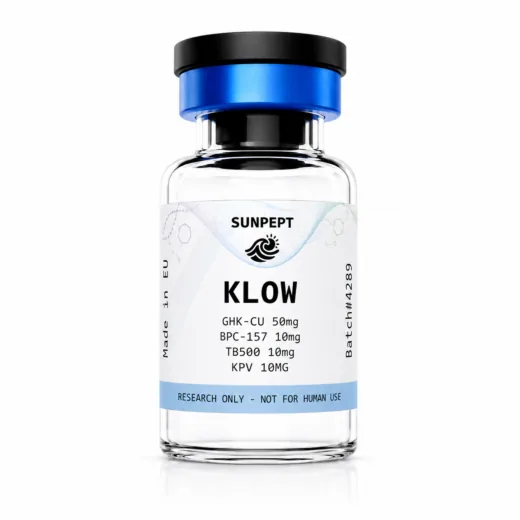
- At SunPept: not available as a single substance – component of KLOW (10 mg)
What is KPV? Origin in α-MSH
α-Melanocyte-stimulating hormone (α-MSH) is a 13-amino-acid peptide formed from the precursor protein proopiomelanocortin (POMC). It acts via melanocortin receptors (MC1R to MC5R), which occur in the central nervous system, on immune cells, and on numerous peripheral cell types[1].
KPV comprises the last three amino acids of this hormone. In 2008, Brzoska and colleagues from Münster summarized research on α-MSH and related tripeptides in a review: in animal models, the full-length hormone showed inflammation-related effects in, among others, skin, intestinal, ocular, airway, and joint models; its pigment-related action was considered an obstacle. The C-terminal tripeptide KPV was described as a variant that shows inflammation-related activity in models but has no pigment-related action[1].
Where exactly is KPV located in the α-MSH sequence?
The sequence of α-MSH is Ac-Ser-Tyr-Ser-Met-Glu-His-Phe-Arg-Trp-Gly-Lys-Pro-Val-NH2. The hormone is acetylated at the N-terminus and amidated at the C-terminus. The central motif His-Phe-Arg-Trp (positions 6–9) is considered the pharmacophore for the melanocortin receptors; KPV forms positions 11–13 at the other end of the molecule. KPV can be synthesized both as a free acid and as a C-terminally amidated variant. When comparing findings from the literature, it is therefore worth checking the methods section to see which form exactly was studied.
KPV and KdPT
The same literature frequently mentions KdPT, a KPV derivative corresponding to amino acids 193–195 of interleukin-1β[1]. KdPT is a separate substance and is not a component of KLOW.
Mechanism of action: what research shows
The mechanism of KPV is less clear than simplified accounts suggest. Three lines of evidence are important.
1. Melanocortin receptors: probably not the main pathway
Binding to melanocortin receptors depends on the core motif His-Phe-Arg-Trp of α-MSH – and that is exactly what KPV lacks. Brzoska et al. (2010) state that KPV completely lacks the sequence motif required for binding to known MC receptors and that the exact signaling pathway is unknown[5]. Getting et al. (2003) reported in a mouse peritonitis model that the effect of KPV on leukocyte migration was not blocked by the MC3/4 antagonist SHU9119, that KPV did not increase cAMP in macrophages, and that the effect also occurred in mice with nonfunctional MC1R. The authors concluded that KPV probably does not act via melanocortin receptors but rather via inhibition of IL-1β functions[4].
2. PepT1 transport into the cell
Dalmasso et al. (2008, Gastroenterology) investigated whether KPV enters cells via the peptide transporter PepT1. PepT1 is a di-/tripeptide transporter that is normally expressed in the small intestine and is also induced in the colon in chronic inflammatory bowel diseases. In human intestinal epithelial cells (Caco2-BBE, HT29-Cl.19A) and T cells (Jurkat), the authors reported that KPV at nanomolar concentrations inhibited the activation of NF-κB and MAP kinase signaling pathways and reduced the secretion of proinflammatory cytokines – mediated via PepT1[2].
3. NF-κB and cytokine signaling
Across several studies, KPV has been associated with a dampening of NF-κB-dependent signals and proinflammatory cytokines[1][2]. Kannengiesser et al. (2008) found indications in mouse models that these effects are at least partly independent of MC1R signaling[3] – consistent with the picture described above.
| Research question | Model | Reported finding | Source |
|---|---|---|---|
| Role of MC receptors | Mouse peritonitis model, macrophages | Effect not blocked by SHU9119, no cAMP increase, also in MC1R-deficient mice | Getting et al. 2003[4] |
| Cellular uptake, signaling pathways | human intestinal epithelial and T cells; DSS/TNBS colitis (mouse) | PepT1-mediated uptake, inhibition of NF-κB/MAPK | Dalmasso et al. 2008[2] |
| Inflammatory parameters in vivo | DSS and transfer colitis (mouse), MC1Re/e-deficient mice | fewer inflammatory infiltrates and lower MPO activity | Kannengiesser et al. 2008[3] |
| Targeted formulation | Hyaluronic acid nanoparticles, colitis model (mouse) | Uptake into epithelial cells and macrophages, lower TNF-α expression | Xiao et al. 2017[6] |
Preclinical inflammation models
KPV research focuses on models of intestinal inflammation:
- DSS and TNBS colitis: Dalmasso et al. administered KPV in drinking water and evaluated histology and cytokine mRNA; a lower incidence of colitis with lower expression of proinflammatory cytokines was reported[2].
- Transfer colitis: In addition to DSS colitis, Kannengiesser et al. also studied CD45RBhi-transfer colitis and reported fewer inflammatory changes in histology and lower myeloperoxidase (MPO) activity in colon tissue[3].
- Nanoparticle formulations: Xiao et al. (2017) loaded hyaluronic acid-functionalized nanoparticles with KPV to specifically target colonic epithelial cells and macrophages, and compared different hydrogel systems in a mouse model[6].
- Peritonitis: Getting et al. studied leukocyte migration in crystal- and IL-1β-induced peritonitis models[4].
The range of models is limited, sample sizes are small, as is typical for preclinical work, and many studies come from a few research groups. On this basis, no conclusions can be drawn for humans.
Safety data and the state of human studies
No clinical studies in humans have been published on KPV, and it has no approval as a medicinal product. Accordingly, there are no human data on adverse events either. Preclinically, Xiao et al. described the KPV-loaded nanoparticles as non-toxic and biocompatible toward intestinal cells[6] – this concerns a specific formulation in cell models and is not evidence of the safety of KPV in humans.
And what about “experiences”?
Searches for “KPV peptide experiences” are common. User reports are not scientifically usable and are deliberately not reproduced here. Only controlled, published data are reliable – and for KPV, these exist solely from cell and animal models.
KPV in multi-component research: KLOW
KPV is the component that distinguishes KLOW from GLOW. While GLOW combines GHK-Cu, BPC-157, and TB-500 – peptides from matrix and vascular research –, KLOW adds a tripeptide from inflammation and melanocortin research to the format. How the multi-component approach is structured and where its limits lie (no proven synergistic effects) is explained in the article GLOW & KLOW. For the other components, you'll find overviews of BPC-157 and GHK-Cu.
Sourcing for research
KPV is not available as a single substance at SunPept. It is a component of the KLOW Vial (lyophilized): GHK-Cu 50 mg, BPC-157 10 mg, TB-500 10 mg, and KPV 10 mg, 80 mg in total. Analysis documentation for KLOW is available on request.
Shipping within the EU from the Czech Republic, payment by prepayment; at checkout, you confirm use for research purposes only. You'll find the current price on the product page. The legal classification depends on the substance, country, and intended use – a neutral overview is given in the article Research peptides and the legal situation offers a neutral overview (not legal advice).
Frequently asked questions
What does KPV stand for?
KPV stands for the amino acid sequence lysine-proline-valine. The tripeptide corresponds to positions 11 to 13, i.e., the C-terminus of the hormone α-MSH, which is formed from the precursor protein POMC. KPV is studied in preclinical inflammation models, particularly in mouse models of intestinal inflammation.
Is KPV the same as α-MSH?
No. α-MSH consists of 13 amino acids, KPV of only the last three. The tripeptide lacks the core motif His-Phe-Arg-Trp, which is required for binding to melanocortin receptors. Accordingly, KPV shows no pigment-related activity in models; its exact signaling pathway is considered unresolved.
How does KPV act according to research?
In cell models, KPV enters intestinal epithelial and immune cells via the peptide transporter PepT1. There, inhibition of NF-κB and MAP kinase signaling and reduced cytokine secretion were reported. One study found indications that KPV acts via IL-1β-related mechanisms rather than via melanocortin receptors. Human data are lacking.
Is there dosing information for KPV?
No. KPV is an unapproved research compound for which no usage or dosing recommendations exist. Concentrations and experimental conditions are defined solely in the respective research protocol. SunPept makes no recommendations on this and offers KPV only as a component of KLOW.
Are there clinical trials or adverse-event data on KPV?
No. Cell culture and animal studies have been published, mainly mouse models of colitis and peritonitis. Controlled studies in humans – and therefore data on adverse events in humans – are not available. Preclinical tolerability data refer to specific formulations in cell models.
Where is KPV included at SunPept?
KPV is included exclusively in the KLOW Vial, together with GHK-Cu, BPC-157, and TB-500 (80 mg in total). KPV is not currently available as a single substance. Analysis documentation for KLOW is available on request; the product is intended exclusively for laboratory investigations.
Sources
- Brzoska T, Luger TA, Maaser C, Abels C, Böhm M. Endocr Rev. 2008;29(5):581-602. doi:10.1210/er.2007-0027
- Dalmasso G, Charrier-Hisamuddin L, Nguyen HT, Yan Y, Sitaraman S, Merlin D. PepT1-mediated tripeptide KPV uptake reduces intestinal inflammation. Gastroenterology. 2008;134(1):166-178. doi:10.1053/j.gastro.2007.10.026
- Kannengiesser K, Maaser C, Heidemann J, et al. Melanocortin-derived tripeptide KPV has anti-inflammatory potential in murine models of inflammatory bowel disease. Inflamm Bowel Dis. 2008;14(3):324-331. doi:10.1002/ibd.20334
- Getting SJ, Schiöth HB, Perretti M. Dissection of the anti-inflammatory effect of the core and C-terminal (KPV) alpha-melanocyte-stimulating hormone peptides. J Pharmacol Exp Ther. 2003;306(2):631-637. doi:10.1124/jpet.103.051623
- Brzoska T, Böhm M, Lügering A, Loser K, Luger TA. Terminal signal: anti-inflammatory effects of α-melanocyte-stimulating hormone related peptides beyond the pharmacophore. Adv Exp Med Biol. 2010;681:107-116. doi:10.1007/978-1-4419-6354-3_8
- Xiao B, Xu Z, Viennois E, et al. Mol Ther. 2017;25(7):1628-1640. doi:10.1016/j.ymthe.2016.11.020
Research Use Only: All substances available from SunPept are intended exclusively for in vitro research and laboratory investigations. They are not medicinal products, foods, or cosmetics and are not intended for human or veterinary use. Learn more at Research Use Only.
The compound from this article in the shop
Vial (lyophilized) or Pen (pre-dissolved), Janoshik analysis reports linked where available. Shipped from the EU to 25 countries. For research purposes only.